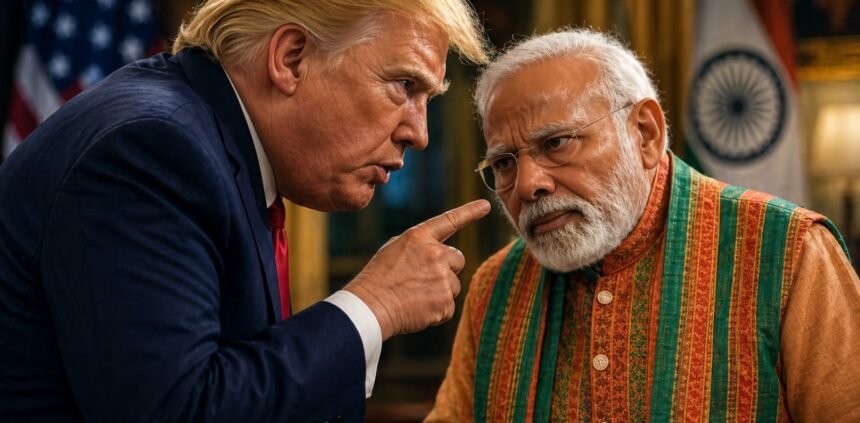
A social media repost by U.S. President Donald Trump has triggered a sharp reaction in India after it amplified language describing India and China as “some other hellhole on the planet” during an argument against birthright citizenship in the United States. The remark, originally made in a message attributed to conservative commentator Michael Savage and then reshared by Trump on Truth Social, quickly set off outrage across Indian media and political circles.
New Delhi answered in unusually direct language. India’s Ministry of External Affairs said the comments were “uninformed, inappropriate and in poor taste,” a formulation that signaled clear displeasure without turning the dispute into a full diplomatic rupture. Indian coverage described the response as stronger than the ministry’s initial guarded line, when it had simply said it had seen reports on the matter.
What made the episode sting more, honestly, is the contrast with the public warmth that has often defined Trump’s dealings with Prime Minister Narendra Modi. Modi formally invited Trump to visit India during a joint press appearance in February 2025, and that history has helped sustain the image of a politically useful personal rapport between the two leaders. This latest controversy cuts straight across that narrative, which is why Indian commentary has treated it as more than just another careless online flare-up.
The repost itself was tied to Trump’s broader campaign against automatic birthright citizenship in the U.S. The message argued that immigrants exploit citizenship rules by having children in America and then bringing relatives from countries including India and China. That framing, already inflammatory in the U.S. immigration debate, landed in India as both a racialized slur and a gratuitous insult aimed at a country Washington still publicly describes as a major strategic partner.
Indian outlets also reported that the U.S. side moved to contain the fallout. According to local reporting, the U.S. Embassy in New Delhi pointed to Trump’s past praise for India and his friendly remarks about Modi, an effort that seemed designed to stop the controversy from hardening into a larger bilateral problem. Even so, the damage was already done online, where the repost was read less as a policy jab and more as a window into how India can still be spoken about in American political rhetoric when immigration becomes the issue.
For now, this looks less like a formal diplomatic crisis and more like a politically awkward moment with real symbolic weight. India has not indicated any wider retaliatory step, but the episode has plainly irritated New Delhi and complicated the polished Trump-Modi imagery both sides have leaned on before. In that sense, the uproar is about more than one repost. It is about the gap between strategic partnership on paper and the language that still surfaces when domestic politics in the U.S. turns hard-edged and xenophobic.