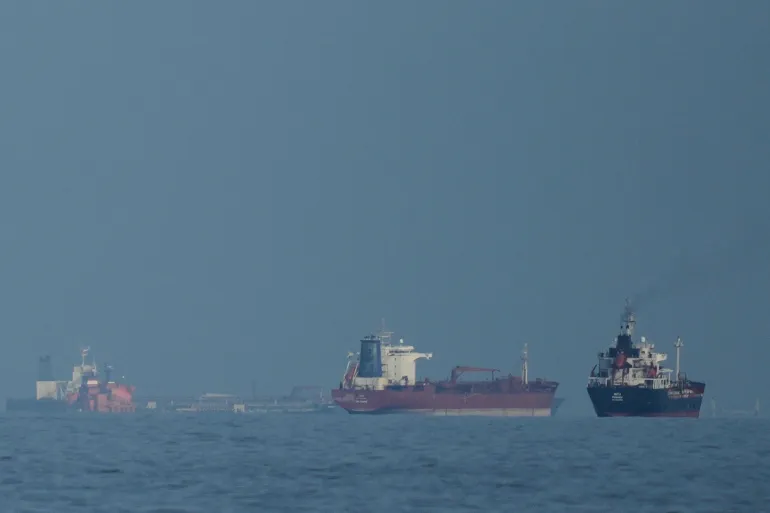
Oil pushed back above $106 a barrel on Friday as traders reacted to a worsening U.S.-Iran standoff in and around the Strait of Hormuz, the narrow waterway that carries a huge share of the world’s seaborne crude. Brent crude was reported at about $106.26 a barrel, while U.S. benchmark WTI traded near $96.80, with the market still treating the strait’s disruption as the single biggest driver of price risk.
The immediate concern is simple, even if the politics around it are not. Hormuz is one of the most important choke points in global energy trade: roughly 20 million barrels a day move through it, equal to about a quarter of the world’s seaborne oil trade, and most of that volume is bound for Asia. Even a short disruption there can send crude sharply higher, and this one has gone on long enough to convince parts of the market that $100-plus oil may not be a brief spike.
What’s pushing prices up now is the sense that diplomacy has stalled just when shipping security is getting worse. The Associated Press reported that Iran’s Revolutionary Guards seized vessels in the strait this week, while the U.S. stepped up interdictions tied to Iranian oil smuggling. AP also reported that planned talks in Islamabad were effectively on hold, with Washington saying no agreement had been reached and Tehran showing little sign it was ready to re-enter negotiations on U.S. terms.
That deadlock has left traders pricing in not just military risk, but confusion over what “open” or “closed” really means in practice. Some reports say the strait may technically be open or partially reopened, yet shipping conditions remain unstable, insurers and operators are still wary, and traffic has not returned to normal levels. In other words, the market isn’t waiting for a formal declaration. It is reacting to whether tankers can move safely and predictably.
The military picture is adding to those nerves. AP reported that President Donald Trump ordered aggressive action against Iranian boats accused of laying mines, and U.S. forces have expanded mine-clearing efforts. At the same time, Washington has increased pressure in the region, with reports that a third U.S. aircraft carrier strike group has arrived in nearby waters. That does not guarantee a wider conflict, but it does make the market’s fear premium feel a lot more real.
There is also a broader strategic worry here. Gulf states and outside analysts have been warning that even if U.S.-Iran talks resume, the most realistic outcome in the near term may be a narrow arrangement focused on restoring movement through Hormuz, not a deeper settlement covering Iran’s regional role or long-running security disputes. Reuters analysis summarized by Al-Monitor said regional officials fear exactly that: a limited fix for shipping, but no true de-escalation.
For consumers and governments, that matters. A prolonged bottleneck in Hormuz does not just threaten crude supplies; it also hits LNG flows and a range of other commodities moving out of the Gulf. So yes, the headline number — oil above $106 — grabs attention. But the bigger story is the one underneath it: markets are betting that Washington and Tehran are still far apart, and until that changes, every incident in the strait will carry outsized weight.