Have you ever noticed that your fingers become wrinkled after spending several minutes in a bath or swimming pool? For years, people assumed that the skin simply absorbed water and became swollen. Scientists now know that the process is more interesting: your nervous system is actively involved.
What Actually Causes the Wrinkles?
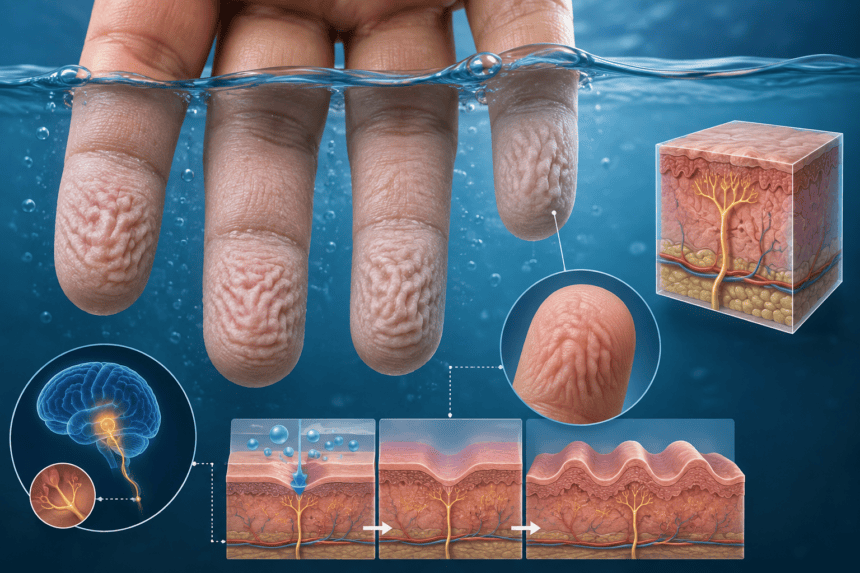
The skin on your fingertips contains many nerves and blood vessels. When your fingers remain submerged in water, the sympathetic nervous system triggers the small blood vessels beneath the skin to constrict. This reduces blood flow and slightly decreases the volume of the tissue in the fingertips. The skin then folds inward, creating the familiar wrinkles.
This is why finger wrinkling is different from ordinary skin swelling. It is an active physiological response, rather than simply water soaking into the skin. Research involving fingers with disrupted nerve connections has also shown that normal wrinkling can disappear when sympathetic nerve function is lost.
Why Do We Have This Response?
Scientists have suggested that wrinkled fingertips may have an evolutionary advantage in wet environments. One study found that people could handle submerged objects more quickly with wrinkled fingers, suggesting that the grooves may help move water away from the fingertips and improve grip.
However, other research has not found a significant improvement in wet-object handling, so the exact evolutionary purpose remains not completely settled.
More Than Just a Curious Effect
Finger wrinkling can also provide clues about the function of the autonomic nervous system. Because the response depends on sympathetic nerve activity, researchers have studied water-induced wrinkling as a possible indicator of certain nerve-function problems.
So, the next time your fingertips look like tiny raisins after a long bath, remember: your body isn’t simply absorbing water—your nervous system is helping create those wrinkles.