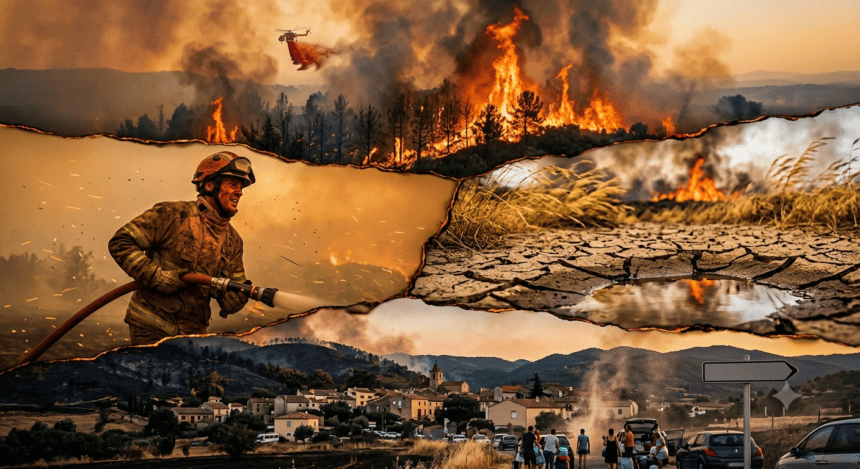
PARIS/MADRID — Emergency crews in France and Spain are battling a fresh surge of wildfires, pushed by record-breaking temperatures and fierce, erratic winds that have complicated containment efforts across the Mediterranean coast.
In southern France, the Gard region has seen thousands of hectares scorched in under 48 hours. The high-speed winds—known locally as the *Mistral*—are effectively turning sparks into firestorms, jumping containment lines and forcing the evacuation of several hillside villages. Firefighters told reporters on the ground that the speed of the fire’s spread is outpacing their ability to establish defensive perimeters.
Across the border in Spain, the situation in Catalonia is equally dire. Regional authorities confirmed that the blaze near the Pyrenees has doubled in size since sunrise. Dry vegetation, starved of rain for months, is acting as a massive fuel source. Spain’s emergency services have deployed specialized forest fire units, but the steep, rugged terrain makes ground-level access nearly impossible for heavy machinery.
The heat is the primary driver. Thermometers in both nations are pushing past 42°C (107°F), creating a “tinderbox” effect. Local meteorologists warned that the current atmospheric instability—the clash between the extreme heatwave and incoming wind fronts—is creating localized fire-driven weather patterns, including fire-tornadoes, which are making the flames unpredictable.
“We are not just fighting the fire; we are fighting the clock,” a lead commander for the French Civil Security told local media. “The wind shifts every twenty minutes. If we don’t break the momentum by nightfall, the coming days will be significantly harder.”
Both governments have shifted resources from urban centers to the fire zones. In Spain, the military’s Emergency Military Unit (UME) has been called in to assist with mass evacuations, while French authorities have grounded some aerial water bombers due to the sheer intensity of the wind gusts, which threaten the safety of the pilots.
For the residents of these regions, the crisis is a grim repeat of previous years, though the scale of the current outbreak is testing the limits of European disaster response protocols. As the sun sets today, the immediate goal for crews is to protect residential zones, knowing that the forecast offers no cooling relief for at least another forty-eight hours.