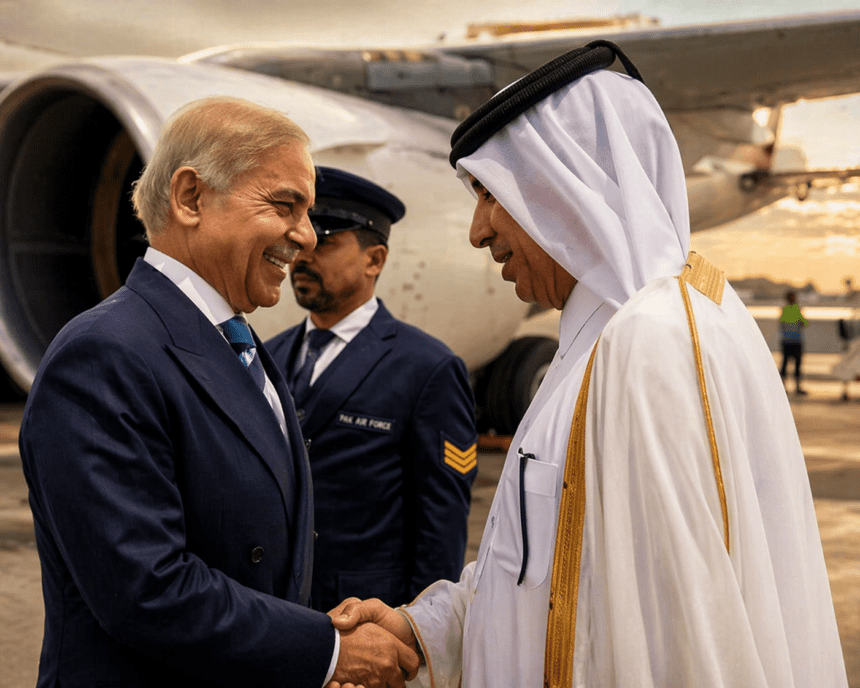
DOHA: Prime Minister Shehbaz Sharif met Qatar’s Emir Sheikh Tamim bin Hamad Al Thani in Doha on Thursday and called for de-escalation, dialogue and close international coordination as Pakistan continued its diplomatic outreach over the worsening regional situation. The meeting came during Sharif’s April 15–18 tour of Saudi Arabia, Qatar and Türkiye, which Pakistan’s Foreign Office said would focus on bilateral ties as well as regional peace and security.
In a statement posted after the meeting, Sharif said he had a “warm and cordial” exchange with the Qatari ruler and that both sides discussed the evolving situation in the Gulf. He said they underscored the importance of de-escalation and dialogue to safeguard peace and stability at a time of rising uncertainty across the region.
The prime minister also reiterated Pakistan’s condemnation of attacks targeting Qatar and other regional countries, and expressed solidarity with the people of Qatar, according to the account carried by Dawn from Sharif’s public remarks. He also thanked the Qatari leadership for what he described as the exceptionally warm reception during his arrival in Doha.
Beyond the immediate crisis, the two leaders reviewed Pakistan-Qatar relations and reaffirmed their intention to deepen cooperation in key sectors. Sharif said the discussions covered security, defence and energy, while an earlier official Pakistani readout from a Doha meeting in February had also highlighted trade, investment, labour mobility and broader institutional engagement as central pillars of the relationship.
Pakistan’s broader message in Doha was consistent with the line it has been pushing for weeks: restraint first, diplomacy next, and no further slide toward a wider regional conflict. The Foreign Office’s curtain-raiser for Sharif’s Gulf trip said his stops in Saudi Arabia and Qatar were meant to address ongoing cooperation along with regional peace and security, showing that Islamabad had framed the visit as more than a routine bilateral engagement from the outset.
The meeting also fit into a wider Pakistani diplomatic push tied to the Middle East crisis. Associated Press reported on Thursday that Pakistan’s army chief, Field Marshal Asim Munir, was in Tehran for high-level talks aimed at supporting fresh U.S.-Iran diplomacy, while Sharif was simultaneously engaging Gulf leaders including the Saudi and Qatari leadership. That parallel outreach suggests Islamabad is trying to keep channels open with multiple capitals as tensions remain volatile.
For Qatar, the conversation reinforced its familiar role as a regional mediator. For Pakistan, it was another chance to present itself as a country backing political solutions rather than escalation. The public language from both Islamabad’s diplomatic messaging and Sharif’s remarks was careful but clear: the preference is for talks, coordination and a calmer Gulf, not another round of open confrontation.