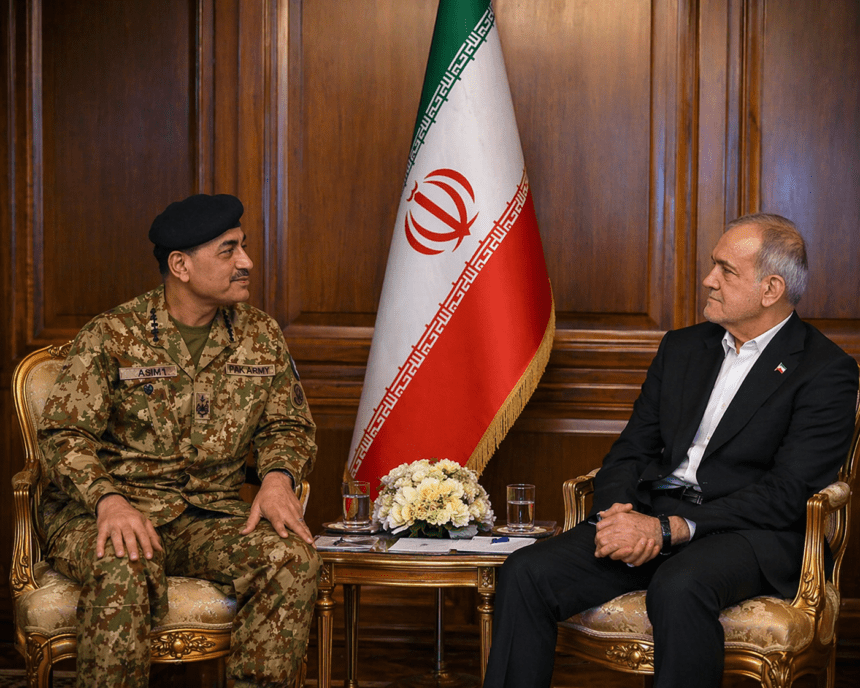
Field Marshal Syed Asim Munir has concluded a three-day official visit to Iran, where Pakistan says the focus stayed on one thing above all else: trying to keep a dangerous regional crisis from sliding back into open conflict. In a statement carried by local media from the Inter-Services Public Relations (ISPR), the military said Munir stressed dialogue and de-escalation as the way to pursue a peaceful outcome to the U.S.-Iran confrontation and to build what it called sustainable regional peace.
According to the ISPR account, Munir travelled with Interior Minister Mohsin Naqvi and a delegation, and during the visit met Iranian President Masoud Pezeshkian. He also held separate meetings with parliament speaker Mohammad Bagher Ghalibaf, Foreign Minister Abbas Araghchi and Major General Ali Abdollahi, commander of Khatam al-Anbiya Headquarters. The talks, the statement said, covered the changing security situation, ongoing diplomatic contacts and possible cooperative steps aimed at long-term regional stability.
The timing matters. Munir arrived in Tehran on April 15, and the visit came just days after high-stakes U.S.-Iran talks in Islamabad ended without a deal after roughly 21 hours of negotiations. Those talks were part of a broader Pakistani effort to preserve a fragile ceasefire and keep communication open between Washington and Tehran even as major disputes remained unresolved.
That wider mediation role has pushed Pakistan, and Munir personally, into an unusually prominent diplomatic position. The Associated Press reported that Prime Minister Shehbaz Sharif had tasked the army chief with maintaining behind-the-scenes contacts with both American and Iranian political and military leaders as Islamabad tried to help de-escalate the crisis. Reuters, in separate reporting, described Pakistan’s diplomacy as a last-ditch effort that helped secure a temporary ceasefire when talks were close to collapsing earlier this month.
Even so, the atmosphere around the diplomacy remains tense. Reporting on April 18 said Iran had again moved to close or restrict traffic through the Strait of Hormuz amid a continuing U.S. blockade, underscoring just how fragile the ceasefire remains and why Pakistani officials are still pushing hard for more talks. AP also reported that another round of negotiations was expected, with Islamabad still seen as a possible venue.
In the official Pakistani version of the trip, Munir also conveyed what the ISPR called the good wishes of Pakistan’s president, prime minister and people, while thanking the Iranian leadership for its hospitality and reaffirming Islamabad’s desire to deepen what it described as historic and brotherly ties with Tehran. It was a familiar diplomatic gesture, sure, but the subtext was hard to miss: Pakistan wants to present itself not just as a neighbour with stakes in regional stability, but as a channel that both sides can still use when the formal talks stall.
For now, that may be the real story behind the visit. No breakthrough was announced in Tehran. No grand agreement emerged. But in a region where the ceasefire still looks shaky and the next escalation never seems far away, Pakistan appears to be betting that keeping doors open counts as progress.