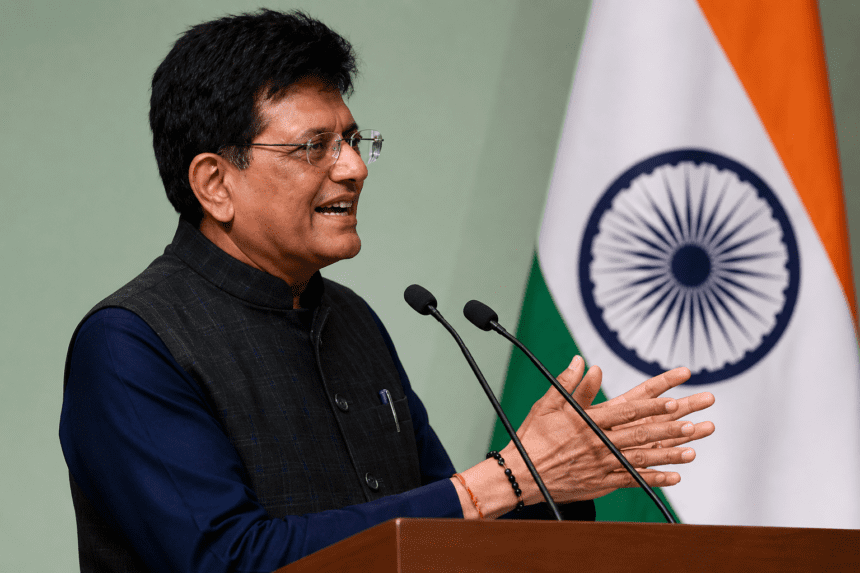
NEW DELHI: India and the United States are close to signing the first phase of a long-discussed bilateral trade agreement, with Indian Commerce and Industry Minister Piyush Goyal saying the deal is almost complete and that only final drafting details remain.
Goyal said the agreement was “about 99%” done, describing the remaining work as a matter of “commas and full stops.” His remarks came as a U.S. trade delegation opened another round of talks in New Delhi on June 2, 2026, in an effort to settle the last unresolved points before the first tranche is formally signed.
The proposed agreement is part of a broader effort by New Delhi and Washington to expand two-way commerce, reduce tariff frictions and bring more predictability to one of the world’s most important trading relationships. Both countries have already set an ambitious goal of raising bilateral trade to $500 billion by 2030, a target that would require deeper market access and fewer regulatory hurdles on both sides.
The latest round of talks, scheduled for June 2-4, is being led on the U.S. side by Assistant U.S. Trade Representative Brendan Lynch, according to Indian media reports. Officials are expected to focus on the final language of the pact, tariff commitments, market access provisions and mechanisms to deal with future trade disputes.
For India, the deal carries both economic and strategic weight. A trade pact with the U.S. could improve access for Indian goods and services in one of its largest export markets, while also reinforcing the wider India-U.S. partnership at a time when both countries are trying to strengthen supply chains outside China.
For Washington, the agreement offers a chance to secure better access to India’s fast-growing consumer market. U.S. negotiators have long pushed India to lower duties on industrial goods, agricultural products and other items where American companies see room for growth. A U.S.-India joint statement earlier this year said the interim arrangement would include Indian tariff reductions or eliminations on a range of U.S. industrial and farm goods, including tree nuts, fruit, soybean oil, wine and spirits.
Still, the final stretch has not been entirely smooth. Market access for agricultural products has traditionally been a sensitive area for India, where policymakers are cautious about decisions that could affect farmers and rural livelihoods. Non-tariff barriers, customs procedures, regulatory approvals and digital trade issues have also featured in past discussions.
Another reported sticking point is Washington’s use of Section 301 investigations, a U.S. trade tool used to examine alleged unfair trade practices. Indian officials are believed to be seeking clarity on how such mechanisms may apply once the first phase of the agreement is in place.
Even so, Goyal’s comments suggest both sides are now closer than they have been in years. His choice of words — that negotiators are down to punctuation — points to a deal that is no longer stuck on big political questions, but on legal language and implementation details.
The first phase is not expected to solve every trade dispute between the two countries. That would be unrealistic. India and the U.S. have clashed in the past over tariffs, digital rules, visa-related concerns, agricultural access and industrial policy. But an initial agreement would create a framework for further negotiations and could help rebuild confidence after years of stop-start trade engagement.
The timing also matters. Global companies are actively looking to diversify manufacturing and supply chains, and India is trying to position itself as a serious alternative production base. A trade arrangement with the U.S. would strengthen that pitch, especially for sectors such as electronics, pharmaceuticals, textiles, engineering goods and technology services.
For now, the message from New Delhi is clear: the first phase is nearly ready. If the remaining details are settled during the current round, India and the United States could soon announce a deal that both sides will present as a practical step toward a much larger economic partnership.