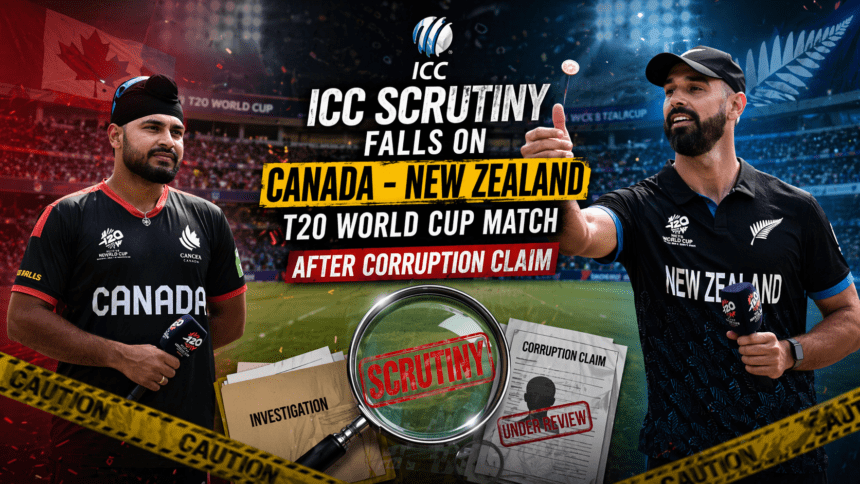
The ICC’s Anti-Corruption Unit has opened an investigation into allegations surrounding Cricket Canada, and one of the matches now under the microscope is Canada’s T20 World Cup group game against New Zealand in Chennai on February 17, 2026. The game itself looked, on the surface, like a routine New Zealand chase: Canada posted 173 for 4, New Zealand replied with 176 for 2 in 15.1 overs, and Glenn Phillips’ unbeaten 76 off 36 sealed an eight-wicket win. But two months later, that fixture is being viewed through a very different lens.
What pushed the match back into the spotlight was a documentary aired in Canada that raised corruption and governance questions around the national setup. Reports say the program pointed specifically to an over bowled by Canada captain Dilpreet Bajwa, and that material has now become part of the ICC ACU’s review. At this stage, that matters: an investigation is not a finding of guilt, and no public charge has been announced by the ICC.
That distinction is easy to lose when a story catches fire. Right now, the confirmed position is narrower than the online chatter. The ICC has not publicly laid out a formal case against any individual player in this match, but its anti-corruption arm is looking into the claims tied to Cricket Canada and the circumstances highlighted in the documentary. The ACU’s job, according to the ICC’s own integrity framework, is to protect cricket under ICC jurisdiction from corruption and to assess reports of possible fixing, betting-related approaches, or attempts to influence participants improperly.
The match details, meanwhile, are not in dispute. Canada’s innings was built around a superb 110 from Yuvraj Samra, with Bajwa making 36 from 39 balls. New Zealand then tore through the chase, driven by Rachin Ravindra’s 59 not out and Phillips’ late assault. Bajwa bowled two overs for 26 runs during the New Zealand innings, a spell now being revisited because of the documentary’s allegations rather than anything the scorecard itself can prove. Scorecards can show what happened. They rarely explain why, and that is exactly where anti-corruption inquiries begin.
There is also a wider problem here for Cricket Canada. The reports are not limited to a single over or a single game. They point to broader governance concerns inside the Canadian cricket system, which gives this story a bigger reach than a straightforward match-fixing allegation tied to one result. Frankly, that may be the more damaging part in the long run. A national board can survive a bad performance. Surviving a credibility crisis is harder.
For the ICC, the stakes are obvious. The governing body has spent years building out its anti-corruption processes, hotlines, reporting systems, and participant codes precisely because T20 cricket, with its compressed format and betting exposure, is seen as especially vulnerable to manipulation attempts. Any claim touching a World Cup game — even before evidence is tested — becomes a major integrity issue.
What comes next will depend on evidence, not noise. The ACU typically works quietly, and these cases can take time because investigators have to piece together video, communications, betting patterns, and witness accounts before deciding whether any anti-corruption code has actually been breached. Until then, the Canada-New Zealand match sits in an uncomfortable place: officially recorded as a convincing New Zealand win, but now shadowed by questions that cricket’s authorities can’t afford to shrug