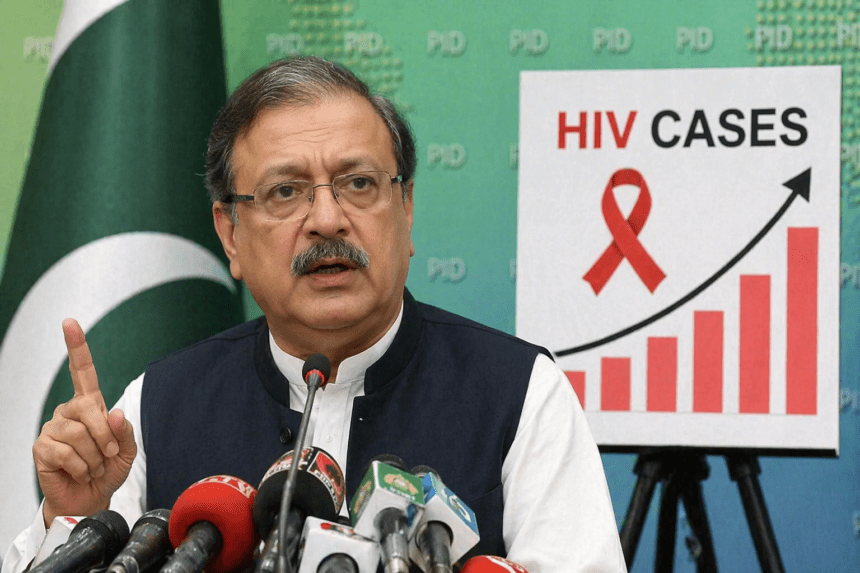
A former minister has warned that HIV cases are increasing in Pakistan, echoing broader alarms already raised by parliament, health officials, and international agencies about the country’s worsening HIV situation. Recent official and public-health reporting shows the concern is grounded in a wider national trend rather than an isolated claim. Pakistan’s National Assembly was told this month that 84,421 people are officially living with HIV/AIDS, with the highest reported burden in Punjab and Sindh.
At the same time, global health agencies say the real scale is likely much larger. The WHO and UNAIDS said in December 2025 that HIV is affecting an estimated 350,000 people in Pakistan, and that 80% do not know their status. They also said Pakistan now has one of the fastest-growing HIV epidemics in the WHO Eastern Mediterranean Region.
The rise has been sharp over time. According to WHO and UNAIDS, new HIV infections in Pakistan rose 200% over the last 15 years, increasing from 16,000 in 2010 to 48,000 in 2024. The agencies say the virus is no longer confined mainly to high-risk groups and is increasingly spreading to children, spouses, and the wider community because of unsafe blood handling, reuse of injections, weak infection-control measures, stigma, and limited access to testing and treatment.
Domestic medical bodies have also sounded the alarm. In January 2026, the Pakistan Medical Association described the rise in HIV cases among children in Sindh as a “high-level alert” and said the number of registered HIV-positive children in the province had climbed to 3,995, including more than 100 new cases in Karachi in 2025 alone. The group blamed illegal clinics, unsafe medical practices, and failures in infection control.
Taken together, these figures show why warnings from political and health figures are growing stronger: Pakistan’s HIV problem is expanding, many patients remain undiagnosed, and experts say the outbreak could worsen without stricter infection control, wider testing, and faster treatment access.