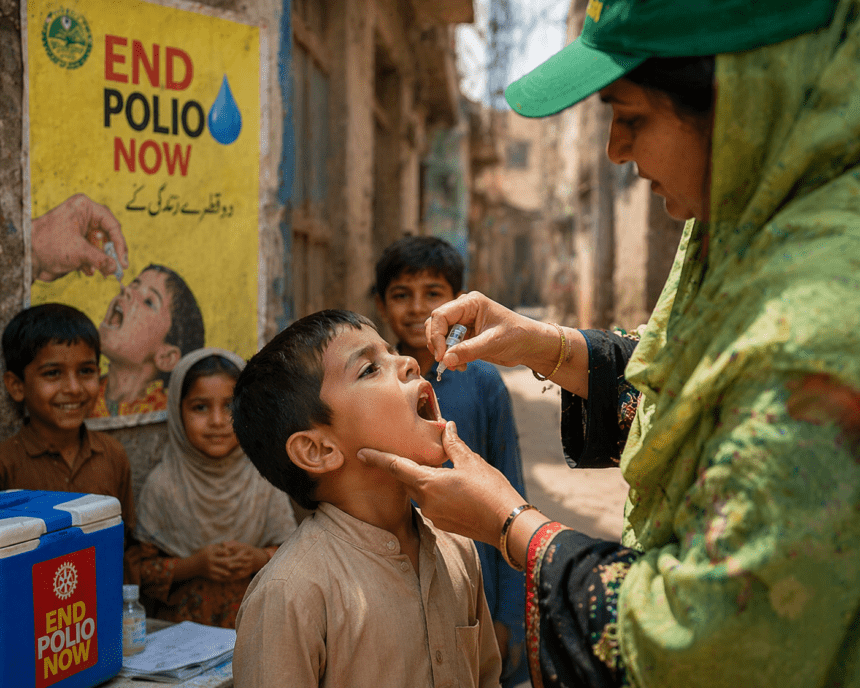
Pakistan’s first nationwide anti-polio campaign of 2026 has reached more than 44.3 million children, officials said, in a mass public-health effort that aimed to protect over 45 million children under the age of five across the country. The campaign, run with the support of more than 400,000 frontline workers, was one of the biggest of its kind this year.
The scale of the drive matters because Pakistan is still one of only two countries in the world where wild poliovirus remains endemic, alongside Afghanistan. Health officials and international partners have kept up repeated door-to-door campaigns, arguing that even a small number of missed children can keep transmission alive.
According to the National Emergency Operations Centre, the campaign ended with more than 44.3 million children receiving oral polio drops. That puts the final figure just below the original target, but still marks a huge logistical push involving vaccinators, volunteers and security personnel working across cities, villages and hard-to-reach areas. WHO-linked reporting said about 400,000 trained workers were mobilized for the campaign.
Officials have tried to frame the campaign as both a health emergency and a test of national coordination. The anti-polio effort has had to move through areas where mistrust, misinformation and security threats still hang over vaccination work. In recent years, militants have repeatedly targeted polio teams and the police assigned to guard them. Since the 1990s, more than 200 vaccinators and their security escorts have been killed in such attacks in Pakistan, according to Associated Press reporting.
That threat has not gone away. As Pakistan launched its second nationwide campaign of 2026 on April 13, a police officer assigned to protect a polio team was killed in Hangu, in Khyber Pakhtunkhwa, and several others were injured. The campaign was still pushed ahead, with authorities saying more than 45 million children were being targeted again in the latest round.
Even so, officials have pointed to some encouraging signs. AP reported that First Lady Aseefa Bhutto Zardari said only one polio case had been recorded in Pakistan in 2026 so far, compared with 31 cases in 2025. That’s not victory, not even close, but it does suggest the campaign pressure may be containing the virus better than last year.
The broader challenge, though, is persistence. Polio eradication in Pakistan has never really been just about vaccine supply. It has been about access, security, public trust and the ability to reach children who are missed in one round and become vulnerable in the next. That is why each campaign is treated almost like a national stress test. Miss too many children, and the virus gets another opening.
For now, the headline figure gives authorities something solid to point to: tens of millions of children reached, a vast workforce deployed, and another step in a long, uneven fight to wipe out a disease that has proven stubbornly hard to eliminate. Pakistan’s officials say the work will continue campaign after campaign until transmission is finally broken.