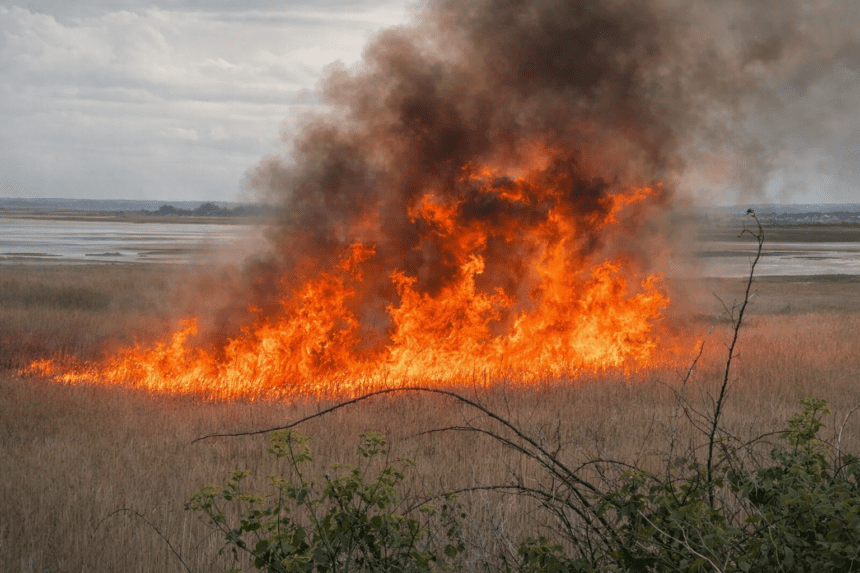
A major fire has struck Coatham Marsh Nature Reserve in Redcar, damaging a protected nesting area and triggering fresh alarm from conservationists who say the loss to wildlife could be severe. Tees Valley Wildlife Trust said the blaze hit the reserve on the evening of June 26, 2025, and described the impact as “devastating,” with birds, eggs, and fragile habitat likely caught in the destruction.
The reserve is not just another patch of open land. Coatham Marsh is a 54-hectare site near Redcar, managed by Tees Valley Wildlife Trust, and forms part of the Teesmouth and Cleveland Coast Site of Special Scientific Interest. It is known as an important wetland habitat and a stopping point for migrating birds, which is why a fire at the height of the nesting season lands especially hard.
In its public statement, the wildlife trust said it had “strong reason to believe” the fire was started deliberately. That has sharpened the tone around the incident. This wasn’t framed as bad luck or a summer accident. It was presented as part of a wider pattern, with the trust warning that fires on reserves and countryside sites across the Tees Valley have become more common.
And that wider concern matters. Fires in protected landscapes don’t just scorch grass for a few days and disappear from memory. They can wipe out nests, destroy eggs before chicks hatch, and strip out the cover birds need to breed safely. Recovery, in places like this, is slow. Sometimes painfully slow. Similar reserve fires elsewhere in Britain have shown how quickly protected reptiles, birds and breeding sites can be lost when flames move through dry habitat.
For local conservation groups, the damage is also symbolic. Coatham Marsh has long been valued as one of the Tees area’s key wild spaces, a rare mix of saltmarsh, freshwater habitat, lakes and meadows on an industrially pressured coastline. So when a fire rips through a nesting zone there, it is not only a story about one evening’s blaze. It becomes a story about how exposed these places really are, especially during warm, dry spells and the breeding season.
The immediate focus now is on assessing the ecological damage and establishing exactly how the fire began. But the message from conservationists is already blunt: what happened at Coatham Marsh was not a minor grass fire. It was a serious hit to a protected wildlife site, and one that may leave its mark long after the smoke has cleared.