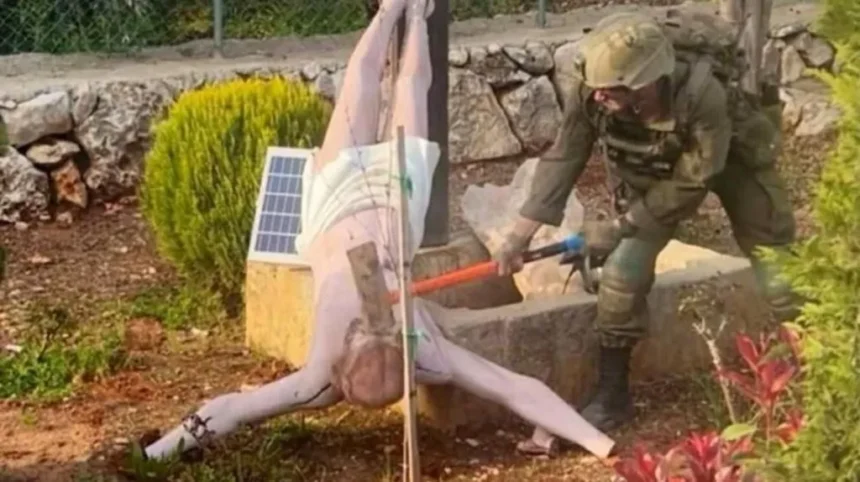
Two Israeli soldiers have been punished after a photograph showing one of them damaging a statue of Jesus in southern Lebanon sparked outrage across Christian communities and drew condemnation inside Israel as well. The incident took place in Debel, a Maronite Christian village near the Israeli border, where the image of a soldier striking the statue spread rapidly online. Israel’s military later confirmed disciplinary action and said the act violated army orders and values.
According to the Israeli military, the two soldiers were removed from combat duty and sentenced to 30 days of military detention. One is accused of physically vandalizing the statue, while the other photographed the scene. The army also said additional soldiers who witnessed the incident without intervening or reporting it are being reviewed for possible disciplinary steps.
The IDF said it “deeply regrets” what happened and moved quickly to contain the fallout. In a separate announcement, the military said troops had replaced the damaged statue in coordination with Debel’s local community, stressing that its operations in Lebanon are directed against armed groups and not civilians or religious sites. Reports from multiple outlets said the replacement was carried out by the Northern Command after the military received notice of the incident.
But the anger did not fade just because the statue was replaced. Catholic leaders in the Holy Land issued what one report described as “unreserved condemnation,” arguing that the desecration struck at a community already living under pressure from war and instability. The image carried unusual weight because Debel is not just any village in south Lebanon; it is one of the area’s best-known Christian communities, and the symbolism of a soldier damaging a figure of Jesus landed hard, fast, and far beyond Lebanon itself.
The case has also revived attention to a broader pattern of concern over damage to Christian symbols in southern Lebanon during the conflict. In April 2025, reports said Israeli forces destroyed a statue of Saint George in the town of Yaroun on Palm Sunday, an episode that had already caused anger in Lebanon. Whether the latest incident was an isolated act of indiscipline or part of a wider failure to safeguard religious sites is now likely to remain part of the public argument.
For Israel, the episode is awkward on several levels. Militarily, it undercuts the army’s attempt to project discipline during operations in Lebanon. Politically, it opens space for critics to argue that misconduct against religious and civilian symbols is not being contained early enough. And diplomatically, it risks inflaming relations with Christian communities at a moment when every image from the border can travel globally in minutes. That, really, is why this story hit so hard: it was not only about one shattered statue, but about what the picture seemed to say in the middle of a deeply combustible war.