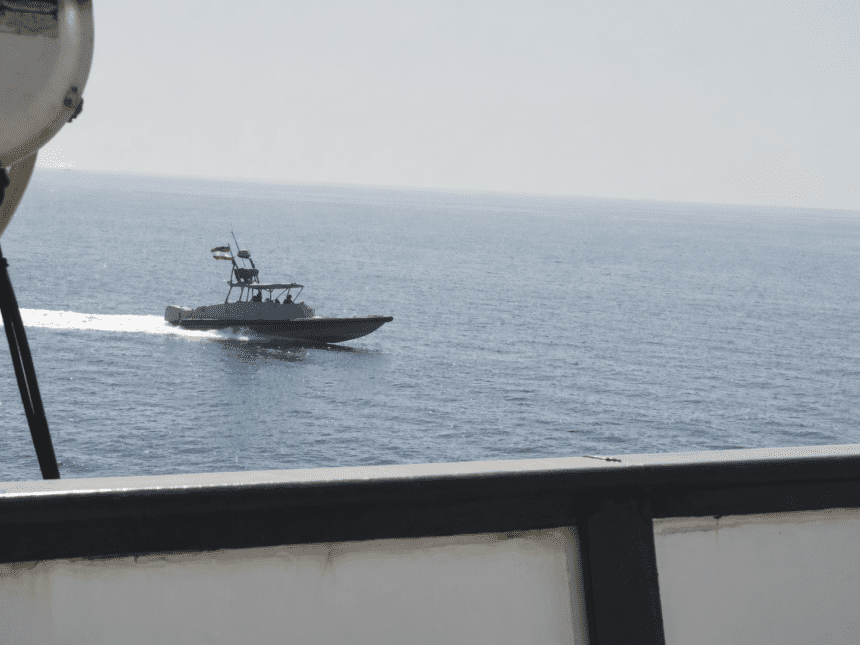
Iran’s use of small, fast attack boats to seize two container ships near the Strait of Hormuz has sharpened fresh concerns for commercial shipping, underlining that even after heavy damage to its conventional navy, Tehran still retains a dangerous and flexible maritime threat. Reuters reported that the episode has complicated any assumption that the waterway can quickly return to normal operations.
What worries shipowners is not just the boats themselves, but the way they fit into a broader pressure campaign. According to Reuters, maritime security firm Diaplous described the tactic as part of a “layered system of threats” that includes shore-based missiles, drones, mines and electronic interference, all aimed at creating confusion and slowing decisions in one of the world’s most sensitive shipping lanes.
That matters because Hormuz is not some marginal route. The International Energy Agency says about 20 million barrels a day of oil, roughly 25% of global seaborne oil trade, move through the strait, while the U.S. Energy Information Administration says flows through Hormuz in 2024 and early 2025 accounted for more than a quarter of global seaborne oil trade and about one-fifth of global oil and petroleum product consumption. Any prolonged disruption there quickly turns into a global energy and freight story.
Reuters’ account suggests Iran has shifted tactics again. Before this week’s ship seizures, it had leaned more heavily on missile and drone attacks around the strait. Now, analysts quoted by Reuters say the fast boats have re-emerged as the practical core of Iran’s asymmetric naval strategy, precisely because they are hard to track, cheap to field, and capable of hit-and-run actions against unarmed merchant ships. Reuters also cited estimates that Iran had hundreds, possibly thousands, of such craft before the war, with more than 100 believed destroyed since February 28.
For the commercial sector, this is a grimly familiar problem. Daniel Mueller of Ambrey told Reuters that civilian shipping is simply not equipped to stop Iranian armed forces from boarding or seizing ships, and that a typical seizure operation can involve about a dozen boats. That gets to the heart of the risk: even if a navy can defeat these craft in a direct fight, merchant crews cannot.
Official maritime warnings show the danger is broader than a single dramatic seizure. UKMTO said maritime access restrictions had been enforced from 13 April 2026 affecting Iranian ports and coastal areas, including locations along the Arabian Gulf, Gulf of Oman and the Arabian Sea east of the Strait of Hormuz. Separately, UKMTO’s latest incident summary said it had received 33 reports affecting vessels in and around the Arabian Gulf, Strait of Hormuz and Gulf of Oman between February 28 and April 20, including 20 attacks and 13 suspicious activity reports.
The Joint Maritime Information Center has kept the regional threat level at critical. Its recent updates say mines are reported near the traffic separation scheme in the Strait of Hormuz, that naval activity is high, and that commercial traffic remains heavily constrained. Another JMIC update said more than thirty maritime incidents involving commercial vessels and offshore infrastructure had been reported since the start of hostilities.
The latest confrontation has also pushed the political temperature higher. AP reported that President Donald Trump ordered the U.S. military to “shoot and kill” Iranian boats laying mines in the strait, after Iranian forces took control of vessels there and after more than 30 ships had reportedly been attacked since hostilities escalated on February 28, 2026. That kind of rhetoric may be intended as deterrence, but for shipping companies it also signals that the operating environment remains volatile and prone to sudden escalation.
The bigger reality is messy. Fast-boat swarms do have limits: Reuters notes they are vulnerable against warships and air power, and rough summer seas can make such operations harder. But that does not make the threat trivial. It just means the danger to merchant shipping comes less from a classic naval battle and more from harassment, boarding, seizure, mines, and the kind of uncertainty that drives up insurance, delays sailings and keeps traffic below normal levels.
For now, the lesson for the shipping industry is pretty stark. Iran’s larger naval losses have not removed the threat in Hormuz. They may have made it more irregular, more fragmented, and in some ways more difficult for commercial operators to predict. And in a chokepoint this important, unpredictability alone is enough to keep the risk premium high.