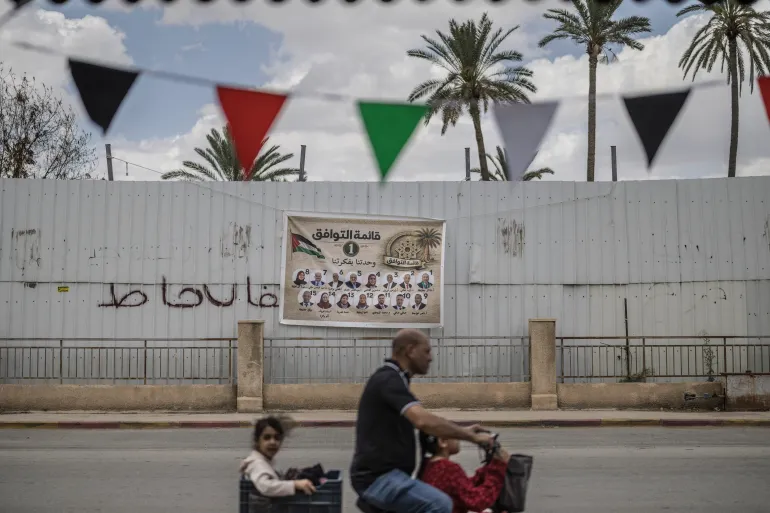
RAMALLAH / DEIR AL-BALAH, April 25, 2026 — Palestinians voted on Saturday in local elections that look, at first glance, like a routine exercise in municipal democracy. They are not. The ballot is really about councils that manage water, roads, sanitation and electricity, but the politics wrapped around it are far bigger: legitimacy, fragmentation, and the strange reality of voting without full control over land, borders or national political life.
The vote is geographically uneven from the start. Across the West Bank, local authorities are being elected in hundreds of municipalities and village councils. In Gaza, though, the election is limited to Deir al-Balah alone after the Palestinian Cabinet postponed voting in the rest of the Strip, leaving a single Gaza municipality in what officials have effectively framed as a limited exception rather than a full return to electoral politics there. The Central Elections Commission says the election now covers 420 local authorities in total.
That matters because the symbolism cuts both ways. On one hand, even a narrow vote in Gaza carries weight: AP reported that this is the first local election there in about two decades, and the first West Bank local vote since the Israel-Hamas war began. On the other hand, a ballot spread across the West Bank but reduced to one municipality in Gaza is plainly not a national democratic renewal. It is a partial, carefully bounded exercise happening inside a divided political system.
And that division is old now, almost painfully old. Palestinians have not held presidential or legislative elections since 2006, while the political split between the Palestinian Authority in the West Bank and Hamas in Gaza has shaped public life since 2007. So voters are being asked to choose local representatives without being given any chance to reset the national leadership that claims to represent them. That’s the first big contradiction at the heart of this vote.
The second contradiction lies in the law itself. The official election framework changed under Decree-Law No. 23 of 2025, which replaced the old local election law, shifted municipalities to open-list proportional representation, and kept simple-majority individual candidacy for village councils. Those are technical changes, but the political controversy centered elsewhere: candidates were also required to sign a declaration committing to the PLO’s program, its international obligations and decisions of international legitimacy. Civil society groups and democracy monitors warned that this amounted to an allegiance test that could narrow the field before campaigning even began.
That criticism is not abstract. AP reported that Fatah dominates candidate slates while other factions stayed away in part because they viewed the new rules as restrictive. So turnout, when it is read later, will not just measure civic enthusiasm. It may also reflect public fatigue with a system where the terms of participation are already tightly managed and where the most consequential offices remain untouched by elections.
There is another layer here, and it’s impossible to separate it from the occupation. Local government in the West Bank does not operate in a normal political environment. OCHA has documented extensive movement restrictions across the territory, including hundreds of obstacles that constrain daily travel and access, while its 2026 humanitarian reporting describes continuing Israeli raids, detentions, settler attacks and community displacement. In that setting, even an effective municipal council works inside sharp physical and political limits.
The violence of the past week only sharpened that reality. AP reported on April 21 that an Israeli army reservist killed two Palestinians, including a 14-year-old boy, near a school in al-Mughayyir during an attack involving settlers and soldiers. One incident does not define an election, but it underlines the atmosphere in which these polls are taking place: one where ordinary local governance exists alongside fear, restriction and recurring deadly force.
So what do these elections represent, if not sovereignty?
They represent municipal survival, first of all. People still need trash collected, power lines fixed, roads repaired and water systems maintained. In places where national politics feels frozen or unreachable, the local council becomes one of the few institutions citizens can still touch, argue with, pressure or replace. That is not nothing. In fact, it may be the only part of Palestinian governance that still feels even partially responsive in daily life.
They also represent a struggle over legitimacy. AP’s reporting says the Palestinian Authority promoted the local races after reforms pushed by international backers and views them as a way to foster public trust and show progress under its leadership. The inclusion of Deir al-Balah, limited though it is, also helps the PA signal that Gaza remains part of the political map it claims to govern. In other words, this is not just an administrative event. It is an argument about who still gets to speak for Palestinians institutionally.
But above all, these elections represent the limits of participation without power. Palestinians can cast ballots, but not for a president or parliament. They can choose who handles local infrastructure, but not who controls borders, airspace, movement, security or the broader diplomatic future. They can participate in governance while remaining far from self-rule. That’s the core tension your headline captures, and honestly, it’s what makes this vote more revealing than transformative.
That does not make the election meaningless. It makes it clarifying. A strong turnout would suggest that many Palestinians still see some value in institutions, even reduced and constrained ones. A weak turnout would point in the opposite direction — to disillusionment with a leadership structure that keeps offering fragments of democratic process while the larger national question remains suspended. Either way, the result will say less about sovereignty achieved than about sovereignty deferred.
For now, the bluntest conclusion is also the simplest: Palestine’s local vote is not evidence that statehood has arrived. It is evidence that political life continues, stubbornly, under conditions that deny Palestinians full control over their own collective future. The ballot boxes are real. The choice is real, too, within limits. But those limits are the story.