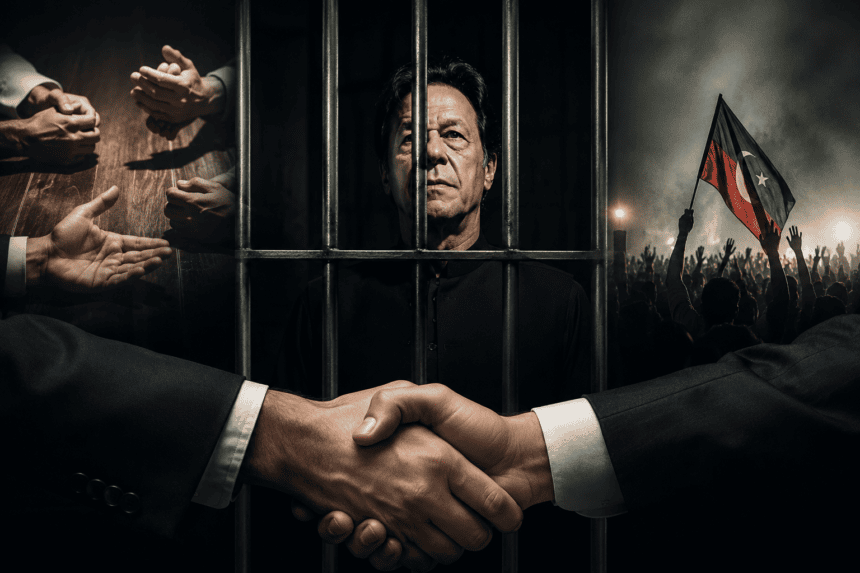
Imran Khan will remain behind bars until a formal deal is reached between the PTI leadership and the country’s power brokers. That is the assessment of Ijazul Haq, president of the Pakistan Muslim League-Zia, who argues that the current legal proceedings against the former prime minister are secondary to the political maneuvering happening behind closed doors.
Haq, speaking during a recent television appearance, dismissed the notion that the judiciary alone holds the key to Khan’s freedom. He suggested that the legal cases—ranging from the cipher controversy to the Al-Qadir Trust case—are merely pieces of a larger puzzle. To him, the resolution of these cases depends entirely on a “settlement” that has yet to be negotiated.
The veteran politician’s comments reflect a growing sentiment among observers who view the PTI founder’s incarceration as a political stalemate rather than a purely judicial matter. While Khan’s legal team continues to fight for bail and acquittal across various courts, political analysts often point to the widening gap between the PTI and the establishment as the primary obstacle to his release.
Haq, who has maintained ties with various political factions throughout his career, did not elaborate on who might be involved in such a deal or what terms might be on the table. However, his remarks underscore a stark reality: in the current landscape, legal victories for Khan have frequently been met with new charges or administrative hurdles.
For the PTI, the messaging remains consistent: the party maintains that Khan is a political prisoner and that his detention is an attempt to dismantle his support base. Party leaders have largely rejected the idea of a “deal,” framing their struggle as one for the supremacy of the constitution rather than a negotiation for personal liberty.
The government, meanwhile, insists that the cases are legitimate and that the judiciary must be allowed to function without political interference.
As the legal battles grind on in the Islamabad High Court and beyond, Haq’s assessment serves as a reminder of the deep-seated skepticism regarding the independence of these proceedings. Whether a deal is in the works or if the legal process will eventually run its course, the future of the PTI founder remains tied to a political climate that shows few signs of thawing.