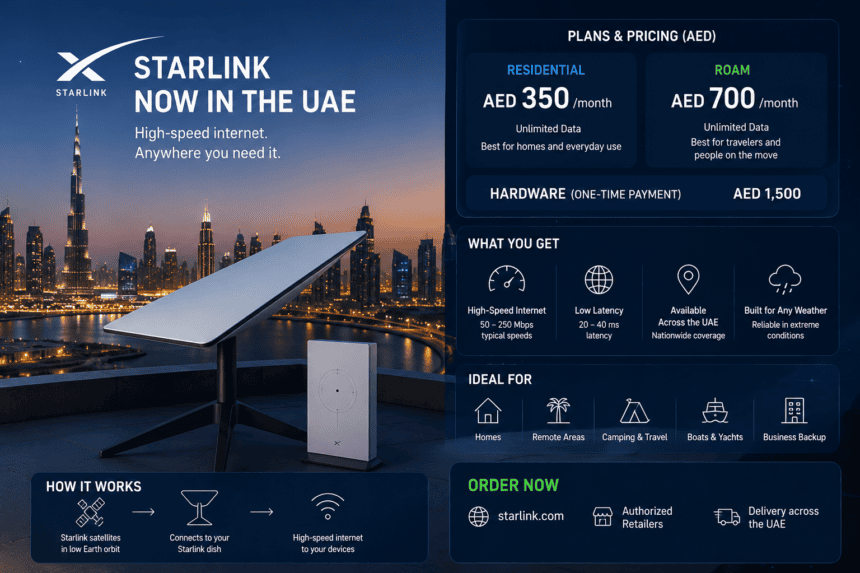
Starlink is officially operational across the United Arab Emirates. The satellite internet provider, owned by Elon Musk’s SpaceX, received regulatory clearance to offer its services to consumers and businesses, ending years of speculation about its entry into the Gulf market.
The service targets areas where traditional fiber-optic infrastructure remains inconsistent or unavailable. While residents in high-density hubs like Dubai and Abu Dhabi already enjoy some of the world’s fastest fixed-line speeds, Starlink’s entry provides a mobile-ready alternative for remote work sites, maritime operations, and desert-based developments.
Pricing begins at AED 1,999 for the hardware kit, a one-time cost that includes the dish, router, and necessary cables. Monthly service fees start at AED 250 for residential users. This price point positions Starlink as a premium alternative rather than a direct competitor to entry-level 5G home packages offered by local giants Etisalat by e& and du.
Industry analysts suggest the move is less about capturing the urban residential market and more about serving the UAE’s industrial sector. Construction firms, logistics hubs, and offshore energy platforms—which often struggle with latency-heavy legacy satellite connections—are the primary targets. By utilizing a “constellation” of thousands of low-Earth orbit satellites, Starlink promises to slash latency times, making real-time data transmission possible in the deepest parts of the desert.
The Telecommunications and Digital Government Regulatory Authority (TDRA) confirmed the licensing, framing it as part of the UAE’s broader strategy to bolster digital infrastructure. The regulatory framework requires Starlink to comply with local data sovereignty laws, a standard hurdle for global tech firms operating in the region.
For the average consumer, the shift is subtle. If you’re already paying for high-speed fiber, the switch offers little in terms of raw download speed. However, for those living in the outskirts of the emirates or managing remote business operations, the arrival of satellite-based high-speed internet marks the end of the “dead zone” era.
SpaceX has not yet disclosed a timeline for expanding capacity, but with the service now active, the focus shifts to how local telecom providers will respond. Whether they view Starlink as a disruptive threat or a niche player, the UAE’s internet landscape just got a lot more crowded.