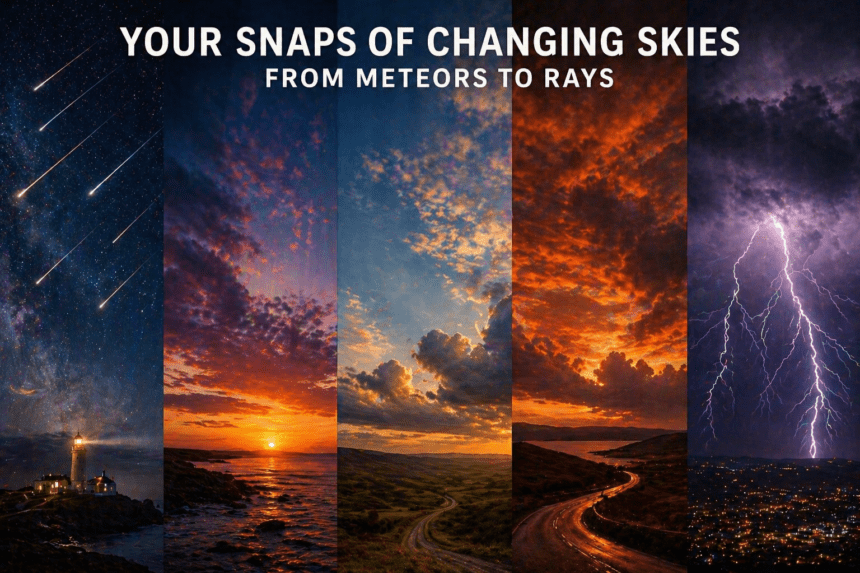
The sky has been putting on a show lately, and people have been looking up. From streaking meteors and sudden fireballs to shafts of sunlight breaking through clouds, recent weeks have delivered exactly the changing skies that turn casual phone pictures into something far more memorable. The timing is no coincidence: April’s Lyrid meteor shower has been active from April 16 to April 25, 2026, with its peak falling around April 22, while NASA has also been highlighting a recent burst of public interest in bright fireball sightings.
For skywatchers, the meteor side of that story has been especially rewarding. The Lyrids are one of the year’s older and more dependable meteor showers, and this year, astronomers said viewing conditions were fairly favorable, with darker skies after the moon set and the best chance of seeing activity in the late-night and pre-dawn hours. Under ideal conditions, observers could catch roughly 15 to 20 meteors an hour, though the actual number always depends on cloud cover, light pollution, and a bit of luck.
Then there are the fireballs — brighter, more dramatic, and often startling enough to stop people mid-sentence. NASA said in March that there had been noticeable excitement around recent fireball events, including a particularly bright daytime fireball seen over parts of the northeastern United States and Canada on March 17, 2026. The agency stressed that while it may feel as if the skies have been unusually busy, these events are not necessarily out of the ordinary; they just capture public attention in a way few other sky phenomena can.
But not every striking sky comes from space. Some of the most eye-catching images come from much closer to home — sunlight breaking through cloud in long radiant beams, shifting weather fronts, and those brief moments when cloud cover and low-angle sun line up perfectly. The UK Met Office noted in March that April often swings between warmth, sunshine, lingering cold air, and unsettled conditions, which helps explain why the skies can seem to change character so quickly at this time of year.
That contrast is part of the appeal. One night, you are outside hoping to catch a meteor flashing near Lyra and Vega. The next day, the scene is all about cloud texture, bright openings, and sun rays spreading across the horizon after a shower passes through. NASA’s April skywatching guide specifically pointed observers toward Vega and the eastern sky for the Lyrids, while the Met Office’s wider spring outlook pointed to dry spells, sunny periods, mist, fog, and then more changeable weather — exactly the recipe for skies that refuse to stay visually dull for long.
What ties all of these images together is not just spectacle, but timing. Sky photography often rewards people who happen to be ready when conditions shift. Meteors last a second. Fireballs can vanish even faster. Sun rays appear and fade as cloud breaks move. That is why these photographs feel so immediate: they capture scenes most people notice only briefly, then lose.
So whether the frame shows a meteor cutting across darkness or sunlight pouring through broken cloud, the same idea runs through it — the sky changes fast, and sometimes beautifully. Recent astronomy events and April’s unsettled weather have simply made that easier than usual to see.