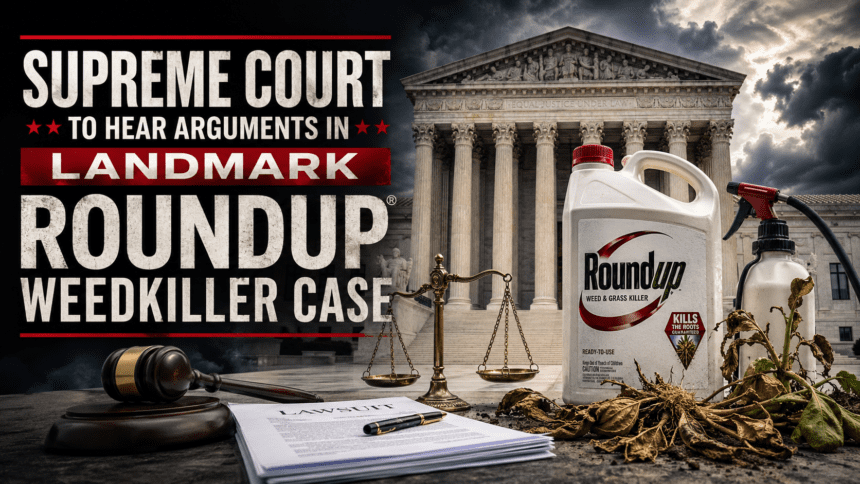
The U.S. Supreme Court is set to hear arguments on Monday, April 27, 2026, in Monsanto Co. v. Durnell, a closely watched case that could reshape the legal future of Roundup litigation in the United States. The case is on the court’s official April argument calendar, and the justices agreed earlier this year to review a narrow but crucial question: whether federal pesticide law blocks state-law failure-to-warn claims when the Environmental Protection Agency did not require the warning in dispute.
At the center of the case is a fight over warning labels on Roundup, the weedkiller made by Monsanto, now owned by Bayer. Bayer argues that because the EPA approved the product’s label without a cancer warning, state juries should not be allowed to impose liability for the absence of one. Plaintiffs say federal approval should not wipe out state-law claims alleging consumers were not adequately warned about cancer risks tied to glyphosate, Roundup’s active ingredient.
The stakes are enormous. The Supreme Court’s ruling is expected to affect thousands of lawsuits claiming that Roundup exposure caused non-Hodgkin’s lymphoma, and it could also shape how courts handle failure-to-warn claims involving other pesticides and regulated products. Recent coverage has described the case as one of Bayer’s biggest legal tests in years, with the company seeking a decisive ruling that could sharply reduce its litigation exposure.
The timing is especially important because Bayer is also trying to lock in a proposed $7.25 billion settlement covering many current and future Roundup claims in the U.S. Bayer has said the settlement and the Supreme Court case are part of the same broader strategy to contain the long-running litigation. Associated Press and Bayer both reported that the proposed settlement would cover most pending and future claims tied to exposure before February 17, 2026, though the arrangement still depends on court approval and broad claimant participation.
For Bayer, a win at the Supreme Court could do more than strengthen its defense in Roundup cases. It could hand the company a wider preemption shield, limiting the ability of consumers to sue under state law when federal regulators approved a label. For plaintiffs, though, a ruling in Monsanto’s favor could shut off one of the main legal paths used to challenge allegedly inadequate safety warnings. That is why the case is being treated as a major test not only for Roundup claims, but for the balance of power between federal regulators and state tort law.
A decision is expected later in the term, likely by June 2026. Until then, today’s arguments will be watched closely by Bayer investors, pesticide manufacturers, plaintiffs’ lawyers and public health advocates alike. It’s not just a product-liability dispute anymore. It’s become a referendum on who gets the final word when a federally approved label is later challenged in court.