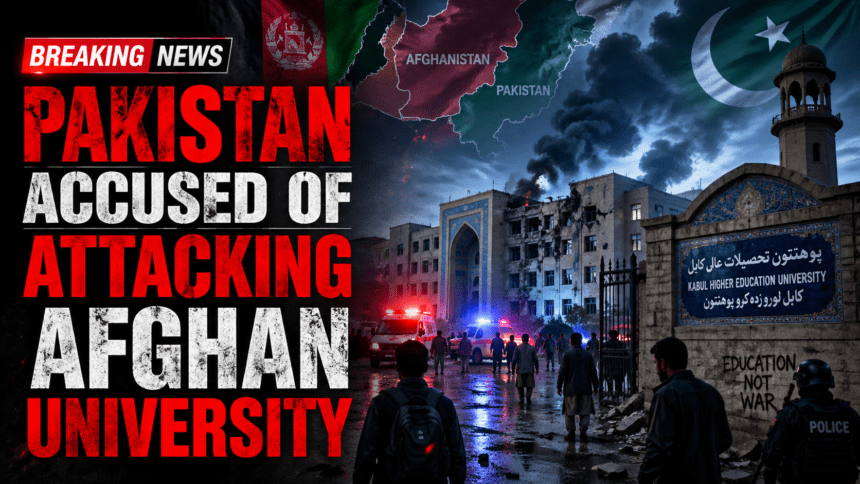
Afghan media and officials have accused Pakistan of carrying out strikes in eastern Afghanistan that damaged Sayed Jamaluddin Afghan University in Kunar province, in an incident that has quickly added to already severe tensions between the two countries. Reports said the attack allegedly hit the university and nearby residential areas, with casualties reported among students, academic staff and civilians.
According to those reports, the strikes were said to have taken place in and around Asadabad, the capital of Kunar, and damage was reported at university facilities including the education faculty. Casualty figures have varied across reports, which is important here: one report said at least seven people were killed and 75 injured, while another, citing Afghanistan’s Ministry of Higher Education, said around 30 students and staff were wounded.
Pakistan, however, has flatly denied the allegation. Pakistan-based reporting said Islamabad rejected Afghan media claims that Pakistani missiles, jets or drones had targeted the university or nearby civilian neighborhoods, calling the reports fabricated. That leaves the core claim contested at this stage, with public accusations from the Afghan side and a direct denial from Pakistan.
That dispute is unfolding in a much larger conflict that has been escalating for weeks. Earlier reporting in late March said Afghanistan had already accused Pakistan of shelling areas on the outskirts of Asadabad in Kunar, killing and wounding civilians. The current period has also been described as the most intense cross-border conflict between the two countries in decades, following renewed fighting that began in late February.
The wider humanitarian picture has also worsened. A recent United Nations humanitarian update said that since late February, cross-border shelling, airstrikes and armed clashes have caused civilian casualties in the several hundreds, including children, and that violence continued even during and after a temporary Eid ceasefire. That backdrop gives the university allegation extra weight, because even before this latest claim, the border conflict was already exacting a heavy civilian toll.
For now, though, one thing needs to be stated carefully: there is no independent confirmation in the material currently available that conclusively establishes responsibility for the reported strike on the university. What is clear is that Afghan outlets and ministries are blaming Pakistan, Pakistan is rejecting the accusation, and the incident has landed at a moment when bilateral relations are already dangerously frayed.