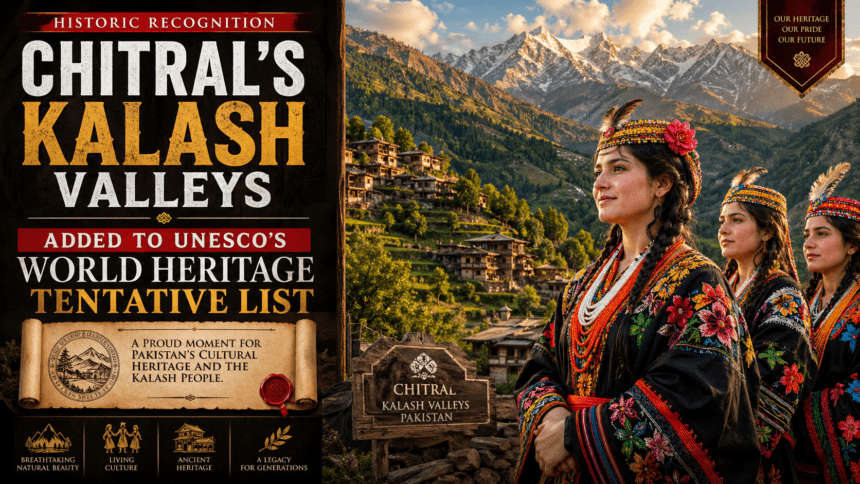
Pakistan has moved the Kalash Valleys of Chitral a step closer to possible World Heritage recognition after UNESCO officially added the “Kalasha Valley Cultural Landscape” to its World Heritage Tentative List. The entry was submitted on March 9, 2026, under cultural criteria (iii), (v) and (vi), and covers the Chitral region in Khyber Pakhtunkhwa. That matters because a place must first appear on a country’s tentative list before it can be formally nominated for inscription on the World Heritage List itself.
So this is not full UNESCO World Heritage status yet. That distinction is important. The tentative list is essentially a country’s official pipeline of sites it may later put forward for final consideration, and UNESCO describes it as the required first step in the nomination process. Still, for the Kalash Valleys, it is a meaningful milestone — one that gives international visibility to a cultural landscape many Pakistanis have long argued deserves stronger protection.
The nomination centers on one of the most distinctive living cultures in South Asia. The Kalash community lives mainly in the three valleys of Bumburet, Rumbur and Birir in Chitral, where religious practice, seasonal festivals, oral traditions, architecture and land use remain closely tied to the mountain landscape. UNESCO’s listing frames the site as a cultural landscape, which means the case is not only about scenery or archaeology, but about the relationship between people, tradition and place.
That is part of why the development feels bigger than a routine bureaucratic update. The Kalash are one of Pakistan’s smallest and most distinctive ethnoreligious communities, and their heritage has already drawn UNESCO’s attention before. In 2018, UNESCO inscribed Suri Jagek — a traditional Kalasha system of observing the sun, moon, stars and shadows for meteorological and astronomical knowledge — on its List of Intangible Cultural Heritage in Need of Urgent Safeguarding. In other words, UNESCO had already recognized an important piece of Kalash knowledge; the new tentative-list move broadens that conversation to the valleys themselves as a living cultural landscape.
The timing also reflects a wider preservation push. Pakistani officials and heritage experts were already publicly discussing a UNESCO pathway for the Kalash Valleys last year. Reporting from October 2025 said heritage authorities in Khyber Pakhtunkhwa and partners from the Commonwealth Heritage Forum had agreed to work toward World Heritage status for both the Khyber Pass and the Kalash Valleys. The new entry suggests that effort has now produced a formal step inside UNESCO’s system.
Why does this matter beyond symbolism? Because the Kalash Valleys are under pressure. Recent reporting and research have pointed to overlapping threats: climate-related flooding, deforestation, tourism pressure, cultural erosion, and the broader vulnerability that comes with being a very small minority community. A tentative-list entry does not solve those problems on its own, but it can strengthen the case for conservation planning, documentation, funding attention and more serious heritage management.
For Pakistan, the listing is significant in another way too. UNESCO’s country page shows Pakistan now has 26 sites on its tentative list, while only a smaller number have reached full inscription on the World Heritage List. That gap has often fueled criticism that Pakistan possesses enormous heritage wealth but has moved too slowly in turning potential into formal recognition. The inclusion of the Kalash Valleys may not close that gap overnight, but it does show fresh movement.
There is, of course, a long road ahead. Getting from the tentative list to the actual World Heritage List usually takes years of dossier-building, conservation planning, political coordination and evaluation. But for the Kalash Valleys, this week’s development is still a real moment: not the finish line, not even close, but a rare and important sign that one of Pakistan’s most fragile living cultures is being recognized not as a curiosity on the margins, but as heritage of possible universal value.