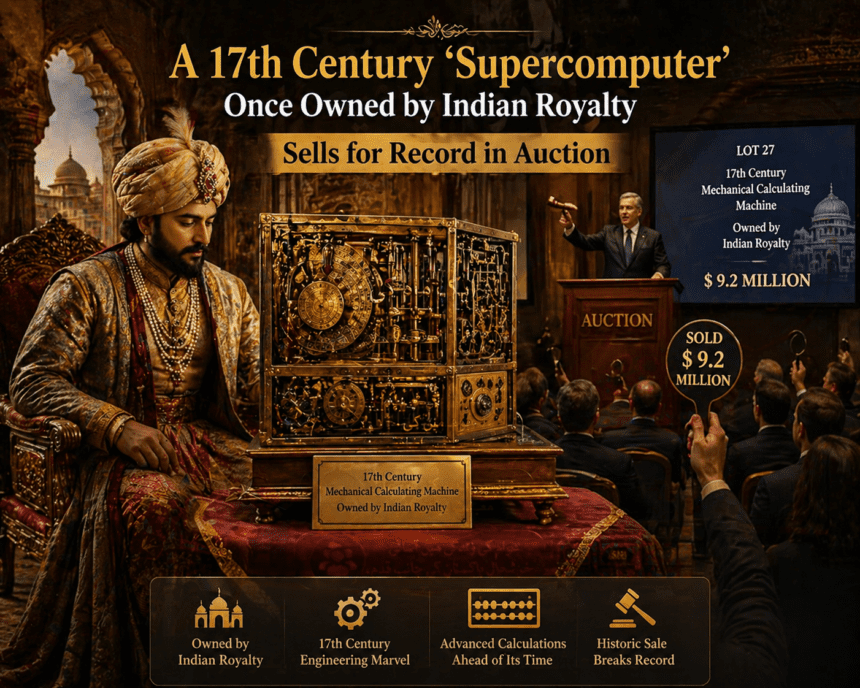
A monumental Mughal astrolabe once held in the Jaipur royal collection has sold for a record price at auction in London, underscoring just how much appetite there still is for rare scientific instruments with deep historical pedigree. Sotheby’s offered the brass device on April 29, and it fetched about $2.75 million, according to post-sale reporting, setting a new auction benchmark for an astrolabe. The instrument had been expected to sell for £1.5 million to £2.5 million before it went under the hammer.
The object being called a “supercomputer” is, of course, no computer in the modern sense. It is an astrolabe, a sophisticated analog calculating instrument used for astronomy, timekeeping, navigation and measurement. Historians often describe astrolabes as mechanical computers because they could help users determine time, map the positions of stars, work out latitude and perform other calculations long before electronic devices existed.
What made this one extraordinary was not just its survival, but its scale and provenance. Sotheby’s identified it as a 1612 Lahore-made astrolabe created by master craftsmen Qa’im Muhammad and Muhammad Muqim of the famed Lahore School, and said it was commissioned for the Mughal nobleman Aqa Afzal during the reign of Emperor Jahangir. The auction house described it as one of only two known astrolabes jointly made by the pair.
It is also unusually large. Reporting on the sale said the instrument stands roughly 18 inches high and weighs more than 18 pounds, making it far bigger than the pocket-sized astrolabes more commonly associated with the period. Sotheby’s specialists said it may be the largest surviving example of its kind, which goes a long way toward explaining the fierce interest around the lot.
Its royal afterlife added another layer of intrigue. The astrolabe later entered the collection of Maharaja Sawai Man Singh II of Jaipur, and after his death it passed to Maharani Gayatri Devi before eventually reaching a private collection in London. That chain of ownership gave the object something auction houses love and collectors rarely ignore: a story that links imperial science, courtly patronage and modern royal provenance in one piece.
The craftsmanship seems to have been a major driver of the result too. The instrument carries engravings naming 38 stars and 94 cities, including Mecca, Lahore, Kashmir, Ajmer and Bijapur, while Sotheby’s highlighted the remarkable precision of its measurement marks. In other words, this wasn’t simply a decorative court object. It was a working scientific instrument made at a time when the Mughal world was also a center of technical skill and mathematical knowledge.
The sale matters beyond the auction room. It reflects a growing willingness among collectors and institutions to treat historic scientific instruments not as niche curiosities, but as major works of material culture. And in this case, the astrolabe’s journey — from Mughal Lahore to Jaipur royalty to a London saleroom — turned it into something bigger than a rare object. It became a reminder that South Asia’s scientific heritage can command the same global attention, and price, as more familiar categories of fine art.