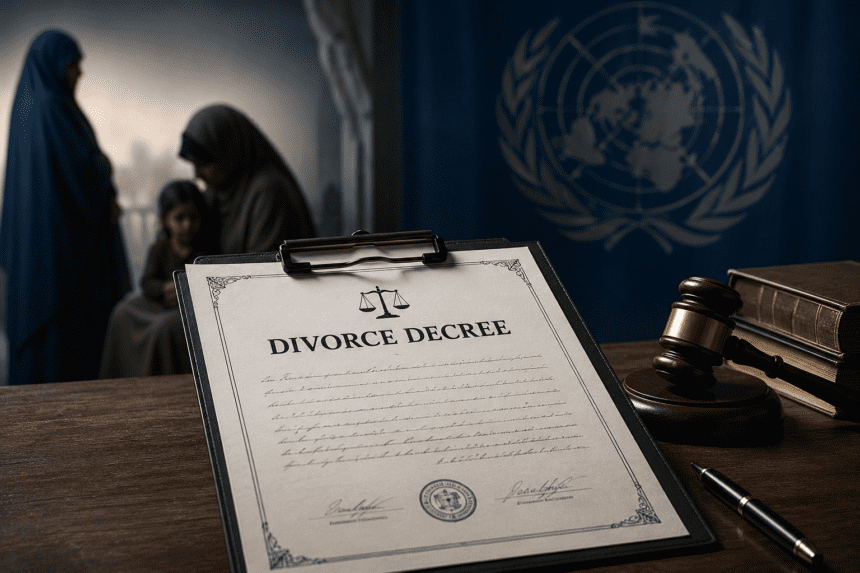
Kabul: The United Nations has warned that a new Taliban decree on marital separation could further entrench discrimination against Afghan women and girls, while appearing to give legal recognition to child marriage in Afghanistan.
The decree, known as Decree No. 18 or the Code on Judicial Separation of Spouses, was published in Afghanistan’s official gazette on May 14, 2026. It sets out rules for how courts should handle separation between husbands and wives, but U.N. officials say several provisions raise serious human rights concerns.
One of the most alarming parts, according to the U.N. Assistance Mission in Afghanistan, is language allowing the silence of a girl who has reached puberty to be treated as consent to marriage. The U.N. said this undermines the principle of free and full consent and fails to protect the best interests of the child.
The decree also includes provisions on separation for girls who reach puberty while already married. U.N. officials warned that this wording appears to assume such marriages can legally exist, raising fears that child marriage is being formalized rather than prevented.
The Taliban government has rejected the criticism. Officials said the decree is based on Islamic law and argued that forced marriage of girls has already been banned. But rights groups say the problem is not only forced marriage on paper. It is the wider reality Afghan girls face: limited education, restricted movement, weak access to courts and pressure from families or local authorities.
Since returning to power in 2021, the Taliban has imposed sweeping restrictions on women and girls. Girls are barred from secondary school and university, many women have been pushed out of most public jobs, and rules on travel, dress and public presence have sharply limited women’s daily lives. Against that backdrop, even a technical legal decree can carry heavy consequences.
For women seeking divorce or separation, the risks are especially serious. Legal pathways in Afghanistan were already narrow, and the new decree may make it even harder for women and girls to challenge marriages they did not freely choose. Rights advocates fear that child brides could be left with almost no safe route out.
The U.N. has urged the Taliban authorities to bring Afghan laws and practices in line with international human rights obligations, including protections for children and women’s right to equality before the law. The warning also adds to growing international pressure over the Taliban’s treatment of women, which many governments and rights bodies describe as one of the world’s most severe gender-rights crises.
Child marriage is not just a legal question. It can end a girl’s education, expose her to early pregnancy, increase the risk of domestic violence and trap her in poverty. In Afghanistan, where humanitarian needs are already severe, rights workers say the consequences could be devastating.
The decree has now turned another spotlight on the Taliban’s justice system. The question is no longer only how courts will handle divorce. It is whether Afghan girls will be protected from being married before they are old enough to make a free choice.
For now, the U.N.’s message is blunt: the new rules risk pushing Afghan women and girls even deeper into a system where their consent, safety and future are not fully protected.