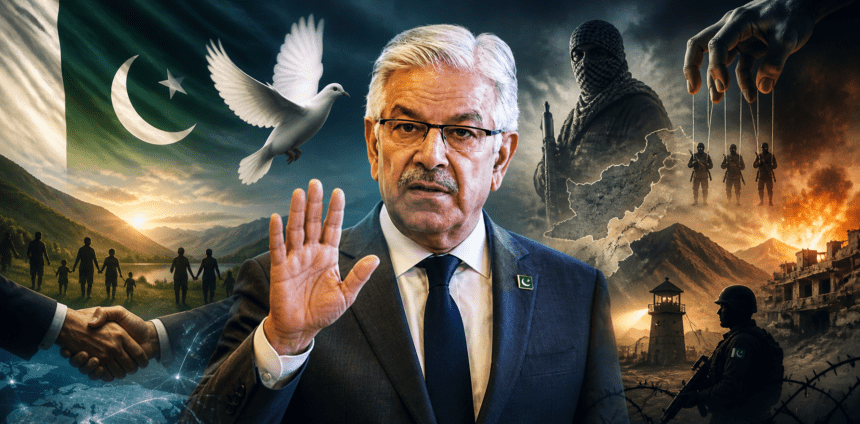
Defence Minister Khawaja Asif has said Pakistan wants peace but is confronting what he described as “proxy” threats, casting the country’s current security challenge as one driven by militant violence and regional rivalry rather than a straightforward conventional war. Recent reporting ties his remarks to Pakistan’s accusations that anti-state groups are operating with outside backing and to renewed friction on the western border.
The statement lands at a tense moment. Cross-border strains with Afghanistan have sharpened again in recent days, with Afghan officials accusing Pakistan of strikes in Kunar province and Pakistan rejecting reports that civilian sites were deliberately targeted. That flare-up came only weeks after China-mediated talks aimed at calming months of border violence, underlining how fragile the situation remains.
Asif’s broader argument is that Pakistan is trying to avoid escalation while still facing security pressure through non-state actors and hostile activity from across its borders. In earlier and related remarks, he linked the threat environment to Afghanistan and India, saying Pakistan was dealing with a “proxy war” dynamic rather than an isolated security problem.
That framing is politically significant because it shifts the debate from one about ordinary border instability to one about external sponsorship and strategic encirclement. It also helps explain why Pakistani officials have been presenting recent militant threats as part of a wider regional contest, not just a domestic law-and-order issue.
For now, the message from Islamabad appears to be two-sided: Pakistan says it still prefers peace, but it is also warning that patience has limits if those proxy threats continue. Whether that language remains rhetorical or feeds into a harder policy response may depend on what happens next along the border and in regional diplomacy.