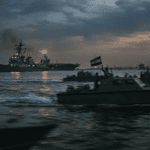
WASHINGTON/ISLAMABAD, April 24, 2026: The United States said Friday that its naval blockade targeting Iranian shipping will remain in place for “as long as it takes,” with Defense Secretary Pete Hegseth signaling no immediate retreat from a strategy that has pushed the confrontation with Tehran deeper into the waters around the Strait of Hormuz.
Speaking as diplomatic efforts flickered back to life, Hegseth said the blockade would continue even as Iran has made lifting it a condition for resuming talks with Washington. The latest U.S. position suggests the maritime pressure campaign is now central to the conflict, not just a side measure.
The blockade itself formally began on April 13, according to U.S. Central Command, which said it would apply to all maritime traffic entering or leaving Iranian ports and coastal areas on the Arabian Gulf and Gulf of Oman. CENTCOM said the operation would be enforced against vessels of all nations using Iranian ports, while adding that traffic transiting the Strait of Hormuz to and from non-Iranian ports would not be impeded.
By Friday, the U.S. message had clearly broadened. Coverage of the Pentagon briefing said Hegseth indicated the blockade would expand, with a second aircraft carrier heading into the Gulf, while Gen. Dan Caine said U.S. forces had already seized merchant vessels in recent days and would continue maritime interdiction operations against what he described as Iranian ships and the “Dark Fleet.”
That escalation comes as the Strait of Hormuz remains at the center of the standoff. The waterway is one of the world’s most sensitive energy chokepoints, and recent reporting says the fighting and shipping restrictions have snarled energy exports and unsettled the global economic picture. Stars and Stripes also reported that commercial traffic through the strait has effectively been disrupted since the conflict intensified, with fuel prices rising as a result.
There was more tough talk from Washington on Thursday and Friday. President Donald Trump said he had ordered the U.S. military to “shoot and kill” small Iranian boats laying mines in the strait, and Hegseth later said the U.S. was confident it could clear mines it identifies, while urging other countries to join that effort. He stopped short of confirming a reported timeline for fully clearing the waterway.
For all the military bravado, diplomacy has not entirely collapsed. Iran’s Foreign Minister Abbas Araghchi was heading to Pakistan on Friday, with stops also planned in Oman and Russia, in what Iranian and Pakistani officials described as a push tied to bilateral issues and regional developments. Pakistani officials, according to the Associated Press, have been trying to bring the United States and Iran together for a second round of ceasefire negotiations.
That gives the day’s developments a slightly strange shape: more ships, harsher warnings, a blockade with no clear end date — and at the same time, a narrow diplomatic opening that nobody seems ready to declare dead. Still, the gap between the two sides remains obvious. Iran wants the blockade lifted before talks move forward; Washington is saying the pressure will stay in place until U.S. objectives are met.
For now, the conflict appears stuck in that uneasy middle ground. The broader war may have shifted away from all-out battlefield exchanges, but the struggle over sea lanes, sanctions-style pressure, and political leverage is still very much alive. And as long as Hormuz stays tense, the fallout will likely keep reaching far beyond the Gulf.