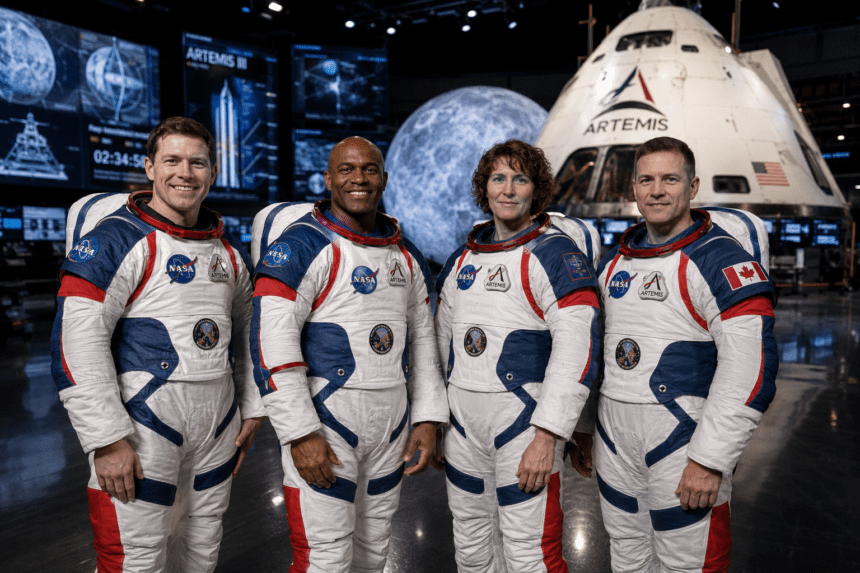
NASA ended months of speculation today by naming the four astronauts assigned to Artemis III, the mission set to return humans to the lunar surface for the first time in over 50 years.
Commander Chris Reid, Pilot Stephanie Wilson, and Mission Specialists Victor Glover and Sarah Hall will lead the expedition. The crew reflects a deliberate shift in NASA’s approach to spaceflight, blending veteran experience with a mandate to land the first woman and the first person of color on the Moon.
The mission centers on the SpaceX Starship HLS, which will serve as the landing vehicle. NASA’s reliance on a commercial partner for the descent marks a departure from the Apollo-era architecture. While the Orion spacecraft will carry the crew to lunar orbit, the handoff to the Starship lander remains the most scrutinized technical hurdle of the mission.
“We are not just going back to leave footprints,” NASA Administrator Bill Nelson said during the announcement at Johnson Space Center. “We are going back to stay, to learn, and to build the infrastructure necessary for the next giant leap toward Mars.”
The crew faces a rigorous 24-month training cycle. They must master the nuances of the Lunar South Pole—a region defined by extreme shadows and suspected water ice deposits. Unlike the equatorial landing sites of the 1970s, the South Pole presents significant navigation challenges due to the jagged terrain and the constant, harsh angle of the sun.
Victor Glover, who previously served as a pilot on the Crew-1 mission, brings critical experience with long-duration stays on the International Space Station. His role on Artemis III focuses on the complex orbital docking maneuvers required to link Orion with the lander.
Critics have pointed to the aggressive timeline. The mission is currently slated for late 2026, but delays in the development of the Starship’s life-support systems and the readiness of next-generation spacesuits have fueled skepticism among industry analysts. If the hardware isn’t flight-ready, the mission window will shift—a reality NASA officials are privately acknowledging.
For the crew, the stakes extend beyond the technical. They represent a global coalition of partners under the Artemis Accords. Their success or failure will dictate the pace of international lunar exploration for the next decade.
Training begins next week. The team will spend the coming months in simulators, replicating the descent to the lunar surface—a descent that will take them into the deepest shadows of the Moon.