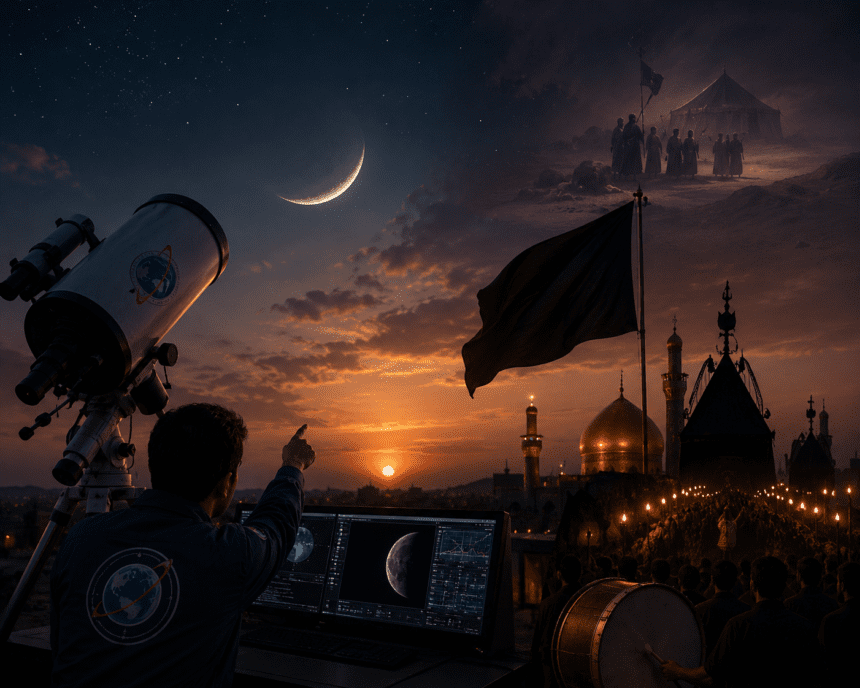
KARACHI — The Pakistan Space and Upper Atmosphere Research Commission (SUPARCO) has projected that the crescent for the month of Muharram is likely to be sighted on the evening of July 7, setting the stage for the start of the new Islamic year.
If the space agency’s calculations hold, the first of Muharram will fall on July 8, placing Ashura — the 10th of Muharram — on Wednesday, July 17.
These projections rely on astronomical data rather than visual confirmation, which remains the final authority for the Central Ruet-e-Hilal Committee. While SUPARCO provides the technical roadmap, the committee will convene on the evening of the 29th of Zilhajj to make the official announcement.
The sighting window on July 7 is critical. According to atmospheric models, the moon’s age and its duration above the horizon after sunset will be sufficient for visibility in most parts of the country, provided the skies remain clear.
For the public, this date carries significant weight beyond the calendar. Muharram marks the beginning of the Hijri year and the onset of a period of deep religious reflection. The government typically announces a two-day public holiday for the 9th and 10th of Muharram, allowing for widespread participation in processions and majalis.
Security preparations are already beginning to take shape. Local administrations in major cities, including Karachi, Lahore, and Rawalpindi, are mapping out sensitive routes for traditional processions. Authorities are expected to finalize their deployment plans once the Ruet-e-Hilal Committee confirms the start of the month.
Until the official announcement from the committee on the evening of July 7, these dates remain, by definition, a technical estimate. Once the sunset arrives, the focus will shift from the space agency’s data to the physical horizon.