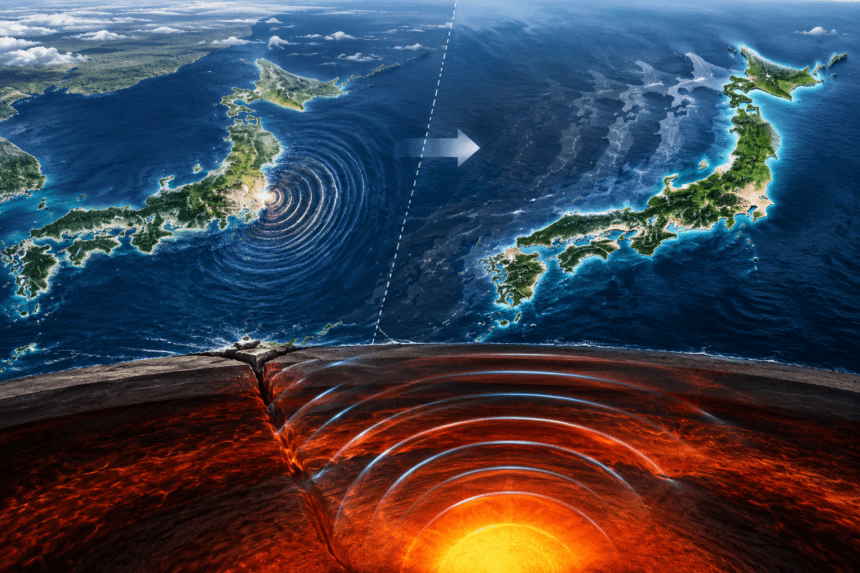
The 2011 Tohoku earthquake didn’t just shake the ground; it fundamentally altered Japan’s physical position. While the initial rupture of the subduction zone triggered the massive tsunami, new seismic analysis reveals a secondary, invisible force pushed the island nation further eastward: waves reflecting off the Earth’s core.
Researchers analyzing high-frequency seismic data discovered that seismic waves traveling downward, bouncing off the dense outer core, and returning to the surface exerted a distinct, sustained force on the Japanese archipelago. These “core-reflected” waves acted as a final shove, contributing to the total displacement of the landmass.
For years, seismologists focused primarily on the crustal slip along the fault line. That movement accounted for the bulk of the shift. However, a discrepancy remained between the expected displacement and the actual GPS measurements recorded across the Tohoku region. This secondary wave interaction fills that gap.
The mechanism is a rare demonstration of deep-earth dynamics influencing surface geography. As the primary earthquake waves radiated outward, a portion of the energy dove deep into the mantle, hitting the liquid iron-nickel outer core. The resulting reflections—specifically the ScS waves—returned to the surface with enough energy to influence the already unstable crustal blocks of northern Japan.
“We are looking at a ripple effect that spans thousands of kilometers,” said one lead researcher on the project. “The core acted like a mirror, reflecting energy back to the surface at the precise moment the crust was at its most vulnerable.”
This finding challenges the conventional model of earthquake displacement, which typically treats the Earth’s interior as a static backdrop. Instead, the core appears to be an active participant in how major seismic events manifest at the surface.
The discovery provides a more precise accounting of how tectonic plates store and release energy. By incorporating core-reflection data, seismologists can now build more accurate models for future mega-thrust events, moving beyond simple surface-level observations.
The Tohoku quake remains the most studied seismic event in history, yet it continues to yield surprises. This shift proves that the consequences of a major earthquake aren’t just limited to the fault line—they resonate through the entire planet, from the surface down to the core and back again.