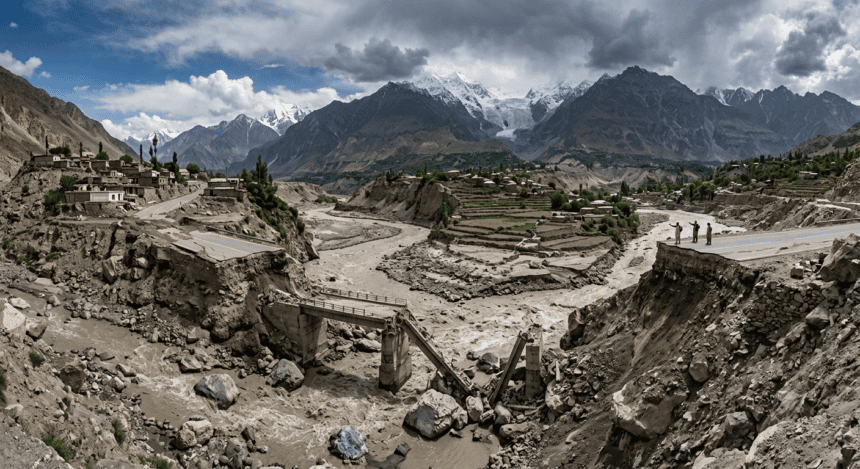
Remote valleys across Gilgit-Baltistan remain isolated today as a series of Glacial Lake Outburst Floods (GLOFs) and torrential rains have shredded vital road networks. Local authorities are struggling to reach cut-off communities, with heavy machinery stuck behind destroyed bridges and washed-away mountain passes.
The damage is concentrated in the Upper Hunza, Shigar, and Ghizer districts. In several areas, the Karakoram Highway—the region’s lifeline—is partially blocked, forcing residents to rely on precarious footpaths or remain entirely stranded. Supplies of food, medicine, and fuel are already running thin in high-altitude settlements where the window for restocking is rapidly closing.
“The water didn’t just rise; it tore through the mountain side,” said a local disaster management official in Gilgit. He noted that the intensity of the GLOFs caught many off-guard, sweeping away temporary river crossings that villagers had built just weeks ago to replace older, damaged infrastructure.
Climate data from the region suggests these events are no longer anomalies. Rising temperatures in the Karakoram range have accelerated the melting of high-altitude glaciers, creating unstable lakes that can burst without warning. While the government has previously promised early warning systems, many of these remote valleys still rely on word-of-mouth alerts passed from shepherds to village elders.
The economic fallout is immediate. Thousands of acres of standing crops have been buried under silt and debris, wiping out the primary income source for hundreds of families. With the main supply routes severed, the price of basic commodities in local bazaars has spiked overnight, putting further strain on families already reeling from the destruction of their homes.
Rescue efforts are currently limited to aerial surveillance and attempts to clear debris by hand. The provincial government has requested additional heavy equipment from the National Highway Authority, but persistent rain and the instability of the saturated soil are making even basic repairs dangerous.
Until the weather clears, these communities remain effectively off the map. For the families in the high valleys, the wait for a road isn’t just about travel—it’s about survival.