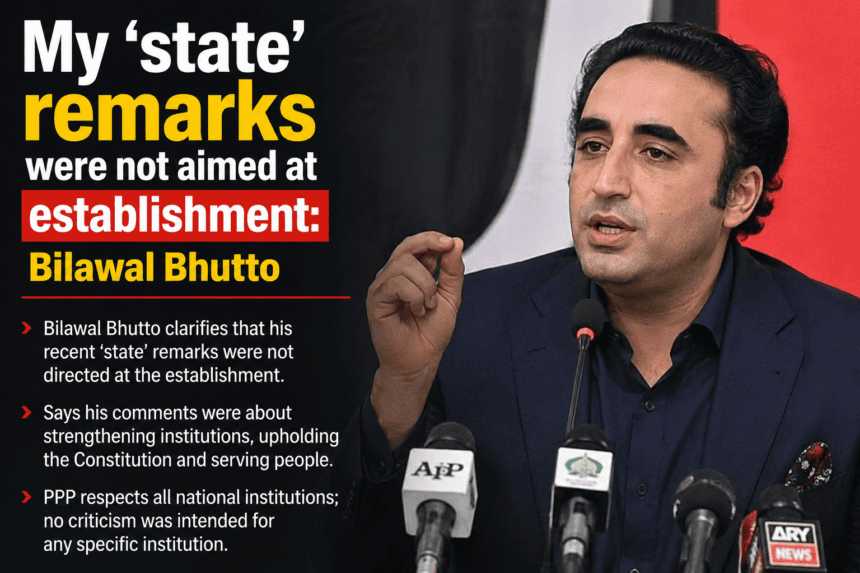
Muzaffarabad: Pakistan Peoples Party (PPP) Chairman Bilawal Bhutto Zardari has clarified that his recent remarks about the “state” were not directed at Pakistan’s establishment, saying his comments had been misunderstood and taken out of context.
Addressing a public gathering in Muzaffarabad, Bilawal said that when he referred to the “state,” he was speaking about the responsibilities of the government and state institutions in ensuring justice, protecting citizens’ rights, and upholding the Constitution. He stressed that his statement should not be interpreted as criticism of the military or the establishment.
Bilawal explained that his remarks were intended to highlight the need for the state to prioritize the national interest over political interests. He said Pakistan’s institutions must remain committed to constitutional principles, democratic values, and the welfare of the people.
The PPP chairman also rejected claims made by political opponents that he had targeted the establishment. He said such interpretations were politically motivated and aimed at creating unnecessary controversy. According to Bilawal, his party has always respected national institutions while believing that every institution should operate within the framework of the Constitution.
During his address, Bilawal also spoke about the situation in Azad Jammu and Kashmir (AJK), where he called for dialogue and reconciliation following recent political tensions. He urged the government and protesters to agree on the formation of a truth and reconciliation commission to investigate the unrest and ensure accountability. He warned against policies that could further deepen political divisions and emphasized that disputes should be resolved through democratic means rather than confrontation.
Bilawal reiterated that the PPP would continue to defend democratic rights, constitutional supremacy, and the rule of law. He maintained that his comments were never intended as an attack on the establishment but were meant to encourage state institutions to act in the broader national interest and safeguard democratic governance.