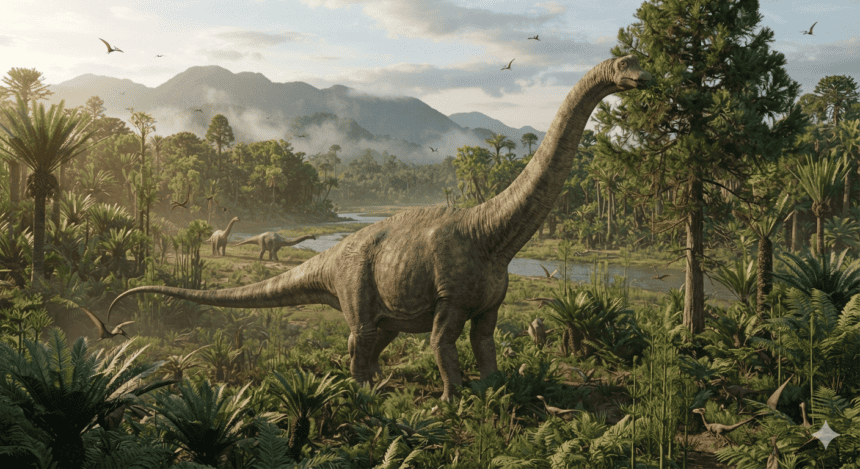
New scientific research has provided fresh insights into the Brontosaurus, one of the most iconic long-necked dinosaurs, helping scientists better understand its anatomy, behavior, and lifestyle. The findings are reshaping what researchers know about this prehistoric giant, often referred to as the “gentle giant” of the dinosaur world.
According to paleontologists, recent studies of fossil skeletons and advanced computer models suggest that Brontosaurus was more agile and adaptable than previously believed. Although enormous in size, researchers say the dinosaur was well suited to moving across ancient landscapes in search of vegetation.
Brontosaurus lived during the Late Jurassic Period, approximately 155 to 145 million years ago. It belonged to the group of giant herbivorous dinosaurs known as sauropods, which were characterized by their extremely long necks, lengthy tails, small heads, and massive bodies.
Scientists estimate that an adult Brontosaurus could reach 22 to 25 meters (72–82 feet) in length and weigh as much as 15 to 20 tonnes. Its long neck enabled it to feed on leaves growing high in trees, while its powerful tail may have been used for balance, communication, or defense against predators.
The latest fossil analysis indicates that Brontosaurus likely grew rapidly during its early years and required enormous amounts of vegetation each day to support its massive body. Researchers are also studying its bones to better understand how such giant animals were able to move efficiently despite their tremendous size.
Experts believe the new research strengthens evidence that sauropods were highly successful dinosaurs, surviving for millions of years because of their efficient body structure and ability to adapt to different environments.
Scientists continue to use modern technologies such as 3D imaging, CT scanning, and digital biomechanical modeling to reconstruct the dinosaur’s movement, posture, and growth with greater accuracy than ever before.
Researchers say the discovery contributes to a deeper understanding of dinosaur evolution and demonstrates how each new fossil continues to improve scientific knowledge of Earth’s prehistoric ecosystems.۔