Scientists have uncovered important new clues about black holes, offering fresh insights into some of the most mysterious and powerful objects in the universe. The latest findings are helping astronomers better understand how black holes form, grow, and influence the galaxies around them.
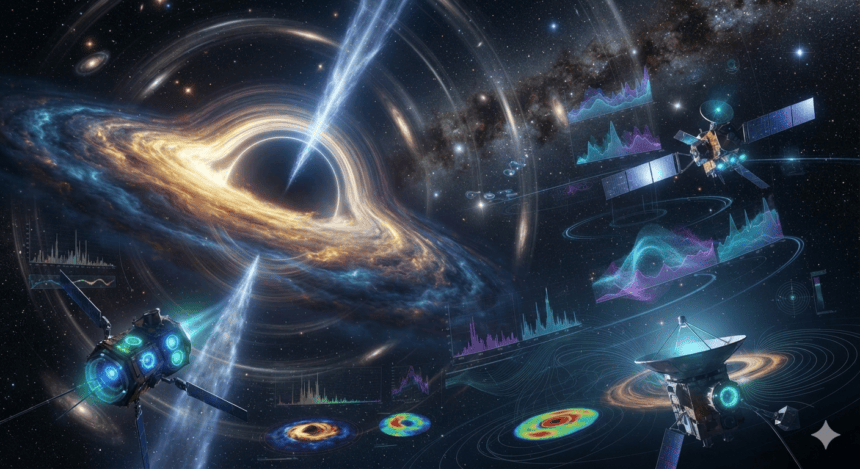
Using observations from advanced space telescopes, powerful ground-based observatories, and computer simulations, researchers have studied the behavior of matter and energy surrounding black holes in unprecedented detail. The research has revealed new information about how these cosmic giants consume nearby material and generate powerful jets of energy that can travel across vast distances in space.
Black holes are regions in space where gravity is so intense that nothing—not even light—can escape once it crosses a boundary known as the event horizon. Most black holes form when massive stars collapse under their own gravity after exhausting their nuclear fuel, while supermassive black holes, containing millions or even billions of times the Sun’s mass, are believed to reside at the centers of most galaxies.
According to astronomers, the latest observations suggest that black holes play a far more significant role in galaxy evolution than previously thought. Their immense gravitational influence can regulate star formation, shape galactic structures, and affect the movement of gas and dust across entire galaxies.
Scientists are also studying gravitational waves—ripples in space-time produced when black holes collide—to better understand these extraordinary events. Combined with artificial intelligence and increasingly powerful telescopes, these observations are opening new windows into the hidden universe.
Researchers emphasize that many questions remain unanswered, including how supermassive black holes formed so early in the universe and what happens to matter inside the event horizon. Future missions are expected to provide even deeper insights into these cosmic mysteries.
Experts believe continued research will not only improve our understanding of black holes but also reveal fundamental secrets about gravity, space, time, and the evolution of the universe itself.