Astronomers have uncovered fascinating new details about the Milky Way Galaxy, providing fresh insights into its structure, history, and the complex processes that continue to shape our cosmic neighborhood.
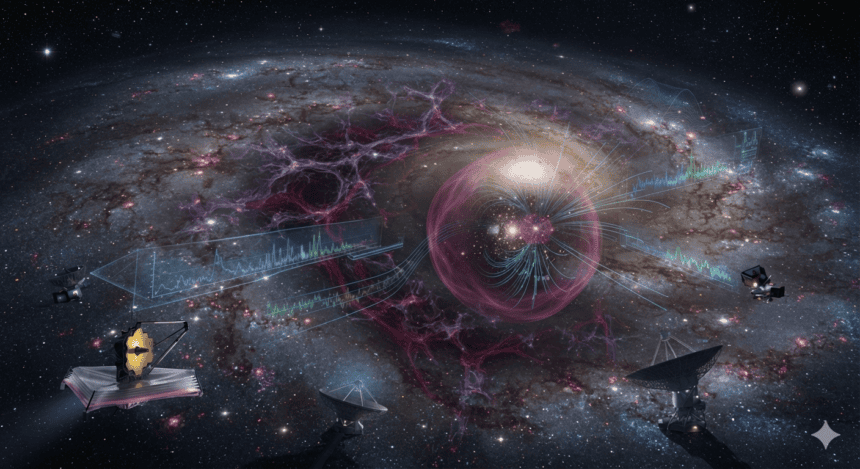
Using observations from advanced space telescopes, radio observatories, and the European Space Agency’s Gaia mission, researchers have mapped millions of stars with unprecedented precision. The new data has revealed previously unknown stellar streams, hidden star clusters, and evidence of ancient galactic collisions that helped form the Milky Way over billions of years.
Scientists explain that the Milky Way is a barred spiral galaxy stretching approximately 100,000 light-years across and containing an estimated 100 to 400 billion stars. Our Solar System is located about 26,000 light-years from the galaxy’s center, where a supermassive black hole, known as Sagittarius A*, resides.
According to researchers, the latest discoveries show that the Milky Way has experienced numerous mergers with smaller galaxies throughout its history. These ancient collisions have influenced the galaxy’s shape, triggered the formation of new stars, and left behind streams of stars that can still be detected today.
Astronomers are also studying enormous clouds of gas and dust scattered throughout the galaxy, where new stars and planetary systems continue to form. These stellar nurseries offer valuable clues about how our own Sun and Solar System may have originated nearly 4.6 billion years ago.
Modern technologies, including artificial intelligence, high-resolution imaging, and advanced computer simulations, are allowing scientists to reconstruct the Milky Way’s evolution with greater accuracy than ever before.
Experts say that despite decades of research, much of our galaxy remains unexplored. Dark matter, hidden star populations, and the detailed structure of the Milky Way’s outer regions continue to be among astronomy’s greatest mysteries.
Researchers believe future space missions and next-generation telescopes will reveal even more about the galaxy’s past, its ongoing evolution, and humanity’s place within the universe.