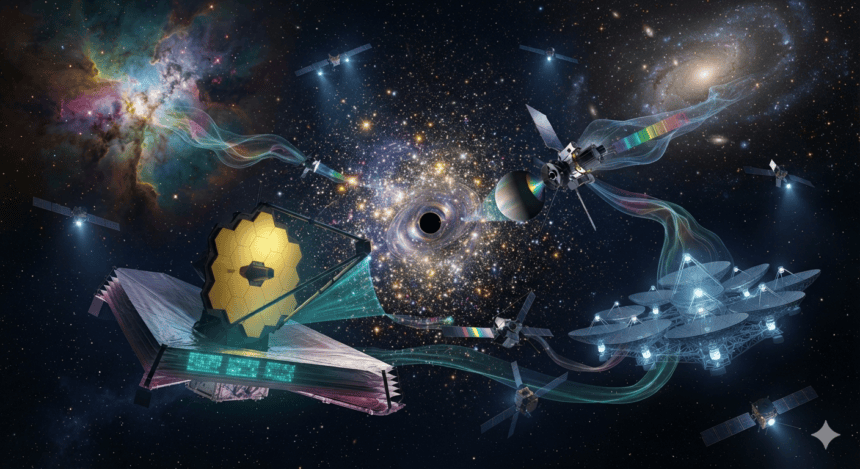
Recent space discoveries are providing scientists with an unprecedented view of the universe, revealing new galaxies, distant exoplanets, mysterious cosmic phenomena, and previously unseen regions of deep space. Researchers say these findings are transforming humanity’s understanding of how the universe formed and continues to evolve.
Using next-generation space telescopes, powerful ground-based observatories, and advanced computer analysis, astronomers have detected some of the oldest galaxies ever observed, along with young star-forming regions and planetary systems located hundreds to thousands of light-years from Earth.
Scientists have also identified new exoplanets orbiting distant stars, including several that may possess conditions suitable for liquid water. While no evidence of extraterrestrial life has been found, these discoveries are helping researchers narrow the search for potentially habitable worlds beyond our Solar System.
Recent observations have also revealed new details about black holes, neutron stars, supernova explosions, and enormous clouds of gas and dust where new stars are continuously being born. These findings are allowing astronomers to better understand the life cycle of stars and the forces that shape galaxies across the universe.
Researchers emphasize that modern technologies—including artificial intelligence, high-resolution imaging, and increasingly powerful telescopes—have dramatically improved humanity’s ability to study the cosmos. Every new mission provides valuable data that helps answer long-standing questions while raising new scientific mysteries.
Experts believe the latest discoveries could eventually improve our understanding of dark matter, dark energy, gravity, and the early moments following the Big Bang. Future international space missions are expected to explore even more distant regions of the universe, offering deeper insights into its origins and evolution.
Scientists say these breakthroughs highlight that the universe remains far larger and more complex than previously imagined, reinforcing the importance of continued investment in space exploration and scientific research.