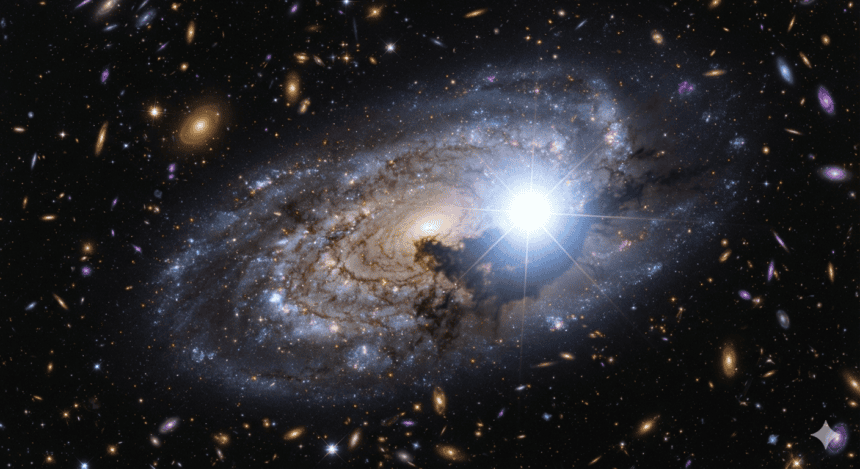
Astronomers have captured a rare supernova explosion in a distant galaxy, providing scientists with a unique opportunity to study one of the universe’s most powerful cosmic events in unprecedented detail.
The explosion was detected using a combination of advanced space telescopes and ground-based observatories, allowing researchers to monitor the event from its earliest stages. Scientists say such early observations are extremely valuable because they reveal how massive stars end their lives and enrich the universe with the elements needed to form new stars, planets, and even life.
A supernova occurs when a massive star exhausts its nuclear fuel and collapses under its own gravity, triggering a colossal explosion. In some cases, supernovae also occur when a white dwarf star accumulates too much material from a companion star and undergoes a runaway thermonuclear explosion.
Researchers explained that the newly observed supernova released an enormous amount of energy within a short period, briefly shining as brightly as billions of stars combined. The explosion also ejected vast quantities of gas and heavy elements into surrounding space, contributing to the formation of future generations of stars and planetary systems.
Scientists are studying the light emitted by the supernova to determine the star’s composition, temperature, and distance. The data may also improve understanding of stellar evolution, black hole formation, neutron stars, and the expansion of the universe.
Astronomers say supernovae play a vital role in the cosmic cycle by distributing essential elements such as carbon, oxygen, iron, and calcium throughout galaxies. These elements later become the building blocks of planets and living organisms.
The research team believes continued observations of this rare event will provide valuable insights into the life cycle of stars and help refine existing models of how galaxies evolve over billions of years.
Experts emphasize that each newly observed supernova offers a rare window into the dynamic processes shaping the universe, bringing scientists one step closer to understanding its origins and evolution.