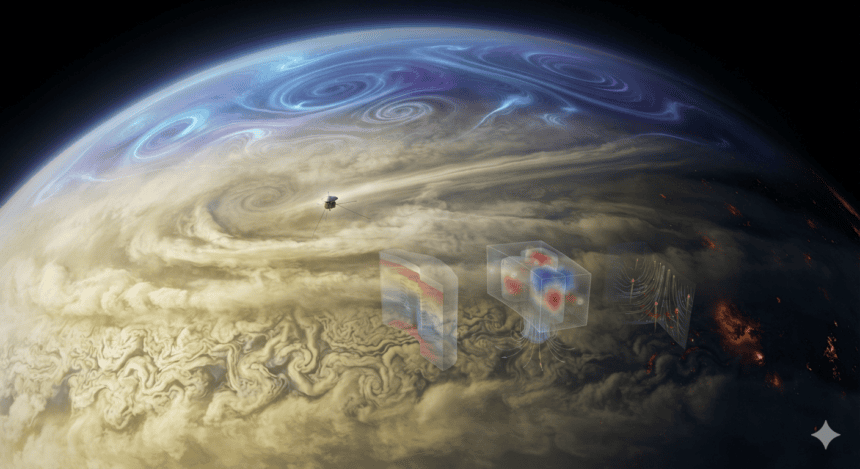
Scientists have uncovered new clues about the mysterious atmosphere of Venus, shedding light on the extreme conditions that make it the hottest planet in the Solar System. The latest research is helping astronomers better understand the planet’s dense clouds, powerful winds, atmospheric chemistry, and long-term climate evolution.
Using data from orbiting spacecraft, ground-based observatories, and advanced computer models, researchers analyzed the composition and movement of Venus’ atmosphere. The findings reveal new details about how heat, gases, and clouds circulate around the planet, creating one of the most hostile environments known in the Solar System.
Although Mercury is closer to the Sun, Venus is the hottest planet, with surface temperatures reaching approximately 465°C (869°F). Scientists explain that its thick atmosphere—made up of about 96% carbon dioxide—creates an intense greenhouse effect that traps heat and keeps the planet extremely hot.
Researchers also studied Venus’ thick clouds, which are primarily composed of droplets of sulfuric acid. These clouds reflect much of the Sun’s light, making Venus one of the brightest objects visible in Earth’s night sky, while also hiding the planet’s surface from ordinary optical telescopes.
One of the biggest mysteries surrounding Venus is a phenomenon known as atmospheric super-rotation, where powerful winds race around the planet in just a few days, even though Venus itself takes 243 Earth days to complete one rotation. Scientists are investigating how these high-speed winds are generated and sustained.
The study provides fresh insights into the interaction between Venus’ atmosphere, volcanic activity, and climate history. Some researchers believe the planet may once have possessed oceans of liquid water before a runaway greenhouse effect transformed it into the scorching world seen today, although this remains an active area of scientific investigation.
Scientists emphasize that studying Venus helps improve our understanding of planetary evolution, climate change, and the atmospheric processes that shape rocky planets throughout the universe. Future missions are expected to reveal even more about Earth’s closest planetary neighbor.
Experts believe that every new discovery brings humanity closer to understanding why Venus and Earth—two planets of similar size—evolved into dramatically different worlds.