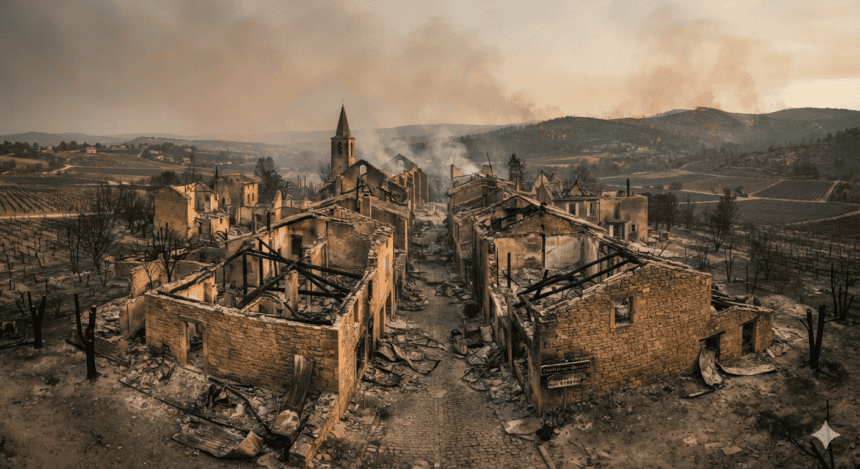
The village of Saint-Félix-de-Pallières no longer breathes. Where residents once tended to terraced gardens and historic stone cottages, only silence remains, punctuated by the occasional rattle of loose shutters against scorched frames.
The fires that tore through the Gard region last August didn’t just burn the pine forests; they hollowed out the community’s social fabric. Within three months of the inferno, 40% of the permanent residents packed their lives into moving vans, leaving behind properties that are now legally classified as uninhabitable.
Local officials are scrambling to manage a landscape defined by ash and insurance litigation. Mayor Jean-Pierre Vaudin sits in a town hall that feels oversized for a population that has dwindled to fewer than 80 people.
“People didn’t just lose their homes,” Vaudin said, gesturing toward the ridge where the flames first breached the tree line. “They lost the ability to imagine a future here. You can rebuild a roof, but you can’t rebuild the feeling of safety once the forest you grew up in is a skeleton.”
The economic fallout is immediate. With the village’s primary appeal—its lush, Mediterranean woodland—reduced to charcoal, the local tourism sector has collapsed. The small café that served as the village’s unofficial parliament shuttered in October, unable to sustain itself on a dwindling customer base.
For the families who stayed, the reality is a daily exercise in isolation. Power lines remain intermittent, and the soil, stripped of its vegetation, now poses a constant threat of mudslides whenever the autumn rains arrive.
Insurance adjusters have proven to be the final blow for many. Many homeowners found their policies didn’t cover “extraordinary fire events” caused by climate-driven heatwaves, leaving them with mortgages for houses they can no longer occupy.
The village is now a collection of “for sale” signs staked into blackened earth. Some owners have slashed prices by 60%, hoping to attract investors or urbanites looking for a rustic project. So far, the only interest has come from land developers eyeing the acreage for timber salvage—an irony not lost on the few remaining locals who spent decades protecting those very trees.
As the sun sets over the valley, the streetlights flicker on for a ghost town. The reconstruction of Saint-Félix-de-Pallières isn’t just a matter of blueprints and lumber; it’s a question of whether a community can survive when its environment has fundamentally turned against it.