Scientists have revealed new discoveries about Jupiter’s powerful storms, providing fresh insights into the dynamic atmosphere of the Solar System’s largest planet. The latest research is helping astronomers better understand how Jupiter’s giant storms form, evolve, and persist for decades—or even centuries.
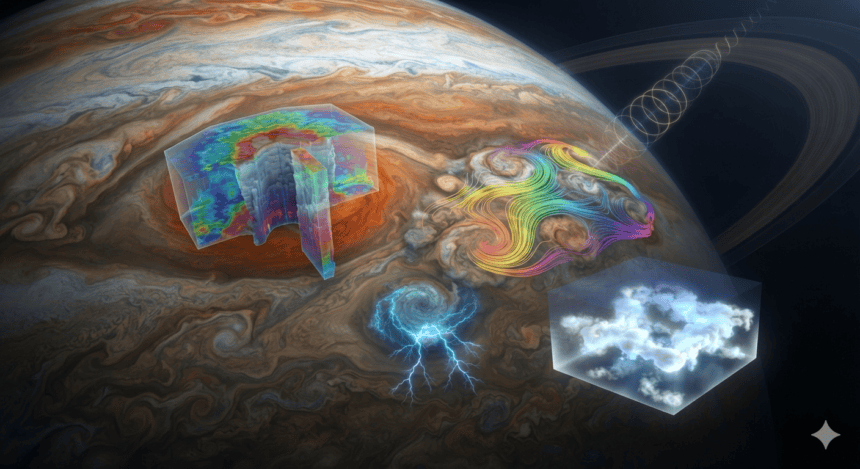
Using data from NASA’s Juno spacecraft, the Hubble Space Telescope, and advanced ground-based observatories, researchers analyzed Jupiter’s swirling cloud bands, lightning activity, and high-speed winds. The findings reveal new details about the planet’s turbulent weather systems and the powerful forces driving them.
One of the main focuses of the study is the Great Red Spot, a gigantic storm that has been raging for at least 190 years, and possibly much longer. The storm is larger than Earth and is powered by powerful atmospheric currents. Scientists found that although the Great Red Spot has gradually become smaller over time, it remains one of the most intense storms ever observed in the Solar System.
The research also discovered that Jupiter experiences enormous thunderstorms capable of producing lightning far more powerful than those on Earth. Deep within the planet’s thick atmosphere, rising gases, heat, and rapid rotation combine to generate violent storms and massive cloud formations.
Scientists explain that Jupiter is composed mainly of hydrogen and helium, with no solid surface. As a result, its weather systems behave very differently from those on Earth, with storms forming deep within the atmosphere and extending hundreds of kilometers below the visible cloud tops.
The study provides valuable clues about Jupiter’s internal structure, atmospheric circulation, and magnetic field. Researchers believe these findings will improve our understanding of how gas giant planets evolve and how similar planets behave around distant stars.
Experts emphasize that studying Jupiter’s storms not only helps explain the planet itself but also contributes to broader knowledge about planetary weather, atmospheric physics, and the evolution of giant planets throughout the universe.
Future observations by the Juno mission and next-generation space telescopes are expected to uncover even more about Jupiter’s extraordinary atmosphere and its ever-changing storms.