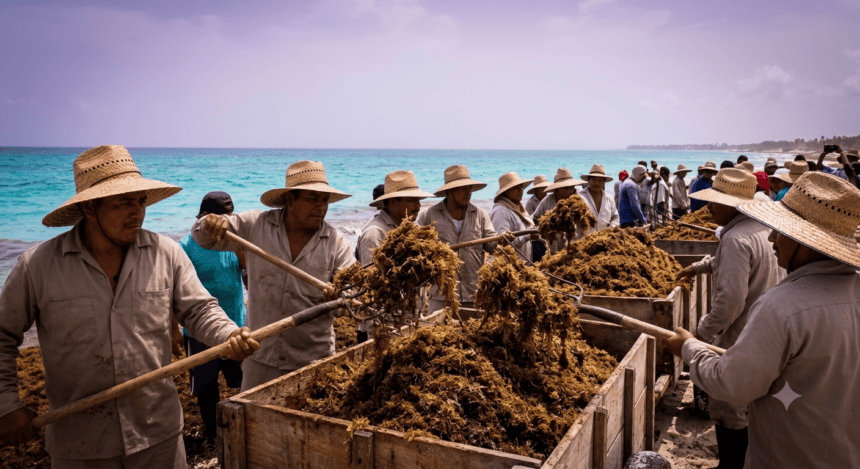
Mexico is deploying its navy to the Caribbean coastline to intercept a massive influx of sargassum, a foul-smelling brown seaweed that threatens to choke the country’s multi-billion-dollar tourism industry.
The seaweed—a macroalgae that blankets beaches in thick, rotting mats—has become a seasonal menace. It doesn’t just look bad; as it decomposes, it releases hydrogen sulfide, creating a pungent “rotten egg” odor that drives tourists away and causes respiratory issues for locals.
President Claudia Sheinbaum’s administration has shifted strategies this year, moving away from reactive beach cleanups toward an aggressive offshore containment model. The navy is installing hundreds of meters of specialized containment barriers, or “sargassum fences,” in the open water. The goal is to catch the algae before it hits the sand, where it becomes nearly impossible to remove without heavy machinery that destroys fragile dune ecosystems.
“We aren’t just cleaning the beach anymore,” said a spokesperson for the Secretariat of the Navy. “We are treating this like a maritime defense operation. If it reaches the sand, we’ve already lost.”
Despite these efforts, the scale of the crisis remains daunting. Satellite imagery from the University of South Florida’s Optical Oceanography Lab shows a massive “Great Atlantic Sargassum Belt”—an expanse of seaweed stretching thousands of miles across the ocean. While not all of it hits Mexican shores, even a fraction of that biomass can bury resorts in Playa del Carmen and Tulum under feet of sludge overnight.
The economic fallout is sharp. Hotel occupancy rates in the Riviera Maya often dip by 20% to 30% during peak seaweed season. Business owners are now footing the bill for private cleanup crews, as government resources struggle to cover the hundreds of miles of affected coastline. Some resorts have turned to using large, specialized vacuum-like vessels to pump the algae out of the water, but the sheer volume of the bloom frequently overwhelms even the most advanced equipment.
Beyond the tourism hit, environmentalists warn of the long-term damage to coral reefs. The decomposing seaweed creates “dead zones” by stripping oxygen from the water and blocking sunlight, which is killing off sections of the Mesoamerican Barrier Reef.
The government has earmarked millions in emergency funding to bolster the navy’s fleet of collection ships, but experts remain skeptical about a total victory. As ocean temperatures rise and nutrient runoff from agricultural fertilizers continues to feed the blooms, the seaweed is arriving earlier and staying longer each year.
For the coastal communities of Quintana Roo, the battle isn’t just about keeping the beaches clean—it’s about keeping their livelihoods afloat. The navy’s new containment strategy is a start, but as the tide rolls in, the success of this season will be measured in feet of clear sand, not just government promises.