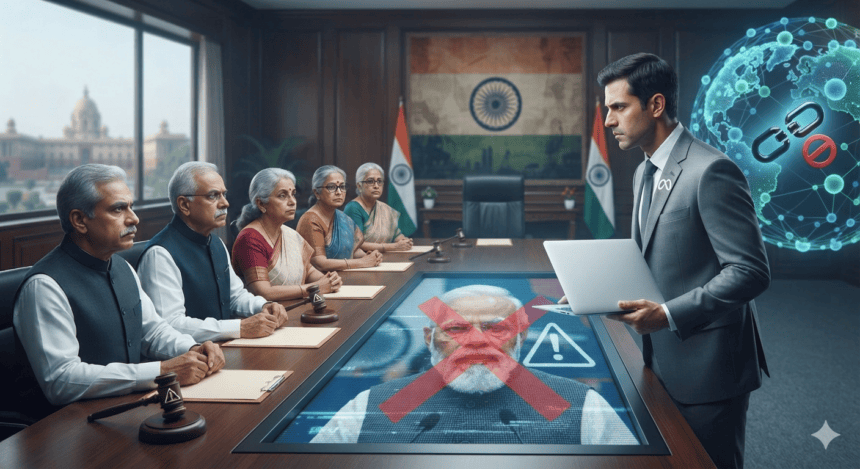
India’s Ministry of Electronics and Information Technology has issued a formal notice to Meta, demanding an immediate explanation regarding the removal of a viral deepfake video depicting Prime Minister Narendra Modi. The government’s move follows allegations that Meta’s platforms—specifically Instagram and Facebook—failed to act with sufficient urgency to contain the spread of the manipulated content, which surfaced during a period of heightened political sensitivity.
The ministry’s directive puts Meta on the spot. Officials argue that the company’s internal safety protocols are failing to trigger fast enough when high-stakes political misinformation hits the feed. For the government, this isn’t just about one video; it’s about the broader question of who controls the narrative on social media during election cycles.
Meta has faced mounting pressure to refine its detection algorithms. While the company claims it maintains strict policies against “synthetic media” intended to deceive users, the government’s intervention suggests these measures are falling short in the eyes of regulators. The ministry’s notice suggests that the platform’s current moderation speed is “inadequate” for a country of India’s scale and digital density.
The video in question—a sophisticated deepfake showing the Prime Minister endorsing specific political stances he never actually took—circulated widely before being pulled. By the time it was removed, the damage was done; the clip had already been downloaded and shared across encrypted messaging apps, where moderation tools have no reach.
This isn’t the first time New Delhi has flexed its regulatory muscle against Big Tech. Under the Information Technology Rules, the government expects platforms to act on takedown requests within hours, not days. Meta’s failure to do so in this instance has prompted the IT Ministry to threaten stricter compliance audits.
Industry analysts point out the difficulty of the task. Meta’s automated systems are designed to flag obvious violations, but nuanced political deepfakes often bypass these filters until a human moderator intervenes—a process that is rarely fast enough to stop a viral trend.
Meta now has a narrow window to respond. If the company’s explanation doesn’t satisfy the ministry, the government could move to amend existing guidelines, effectively stripping platforms of their “safe harbor” protections for failing to police AI-generated content. For Meta, the cost of a formal confrontation with New Delhi could be far higher than the cost of upgrading its moderation software.