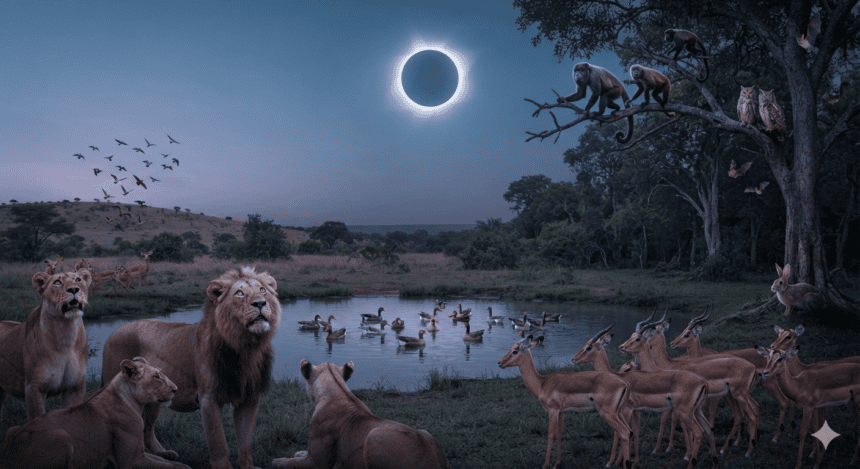
Animals don’t just sense a solar eclipse; they react to it as if the world is ending.
When the moon slips in front of the sun, casting a midday shadow across the landscape, the biological rhythms of wildlife fall into chaos. Diurnal animals—those active during the day—suddenly prepare for sleep, while nocturnal creatures stir from their dens, confused by the abrupt shift from light to dark.
The phenomenon is less about the visual spectacle and more about the sudden drop in temperature and light intensity. These environmental cues trigger internal biological clocks, or circadian rhythms, that are finely tuned to the sun’s position.
During the 2017 total solar eclipse, researchers at the Riverbanks Zoo in South Carolina observed erratic behavior across dozens of species. Gorillas, typically busy foraging or socializing, began moving toward their sleeping quarters. Giant tortoises, usually sluggish, suddenly became active, pacing their enclosures as if searching for an exit. Even the giraffes, often stoic, started running in a state of agitation.
It isn’t just captive animals that lose their way. Songbirds, which usually maintain a steady chorus throughout the day, fall silent as the sky darkens. Nocturnal insects like crickets begin their evening chirping patterns. Spiders have been documented dismantling their webs, a ritual they typically perform at dusk.
For these animals, the eclipse acts as a biological “glitch.” They lack the cognitive capacity to understand the celestial mechanics of an eclipse. Instead, they rely on light-dependent triggers to manage their survival. When that light vanishes without warning, their instincts force an immediate transition into “night mode.”
The confusion extends to pets, though often in more subtle ways. Dogs and cats may become anxious or seek shelter, mirroring the sudden atmospheric tension. Veterinarians often advise owners to keep pets indoors during an eclipse, not because the light itself is harmful, but because the behavioral unpredictability of animals can lead to unexpected accidents.
While the sun returns within minutes, the physiological reset isn’t always instant. Researchers have noted that some species remain agitated long after the light returns, struggling to recalibrate their internal clocks to the sudden resumption of the day.
For the animal kingdom, an eclipse is a stark reminder of just how fragile their connection to the sun really is. When the lights go out, instinct takes the wheel—and logic is left in the dark.