The USS *Minneapolis* wasn’t in Spanish waters for a naval engagement in August 1905. Instead, the protected cruiser was anchored off the coast of Spain to capture a fleeting, three-minute window of total darkness.
While history books often focus on the scientific expeditions of the era, the U.S. Navy’s direct involvement in documenting the 1905 total solar eclipse remains a largely overlooked chapter of maritime history. Navy personnel, working alongside civilian astronomers, turned the ship’s deck into a makeshift laboratory to track the moon’s shadow as it raced across the Iberian Peninsula.
The mission was high-stakes. Astronomers of the early 20th century viewed the 1905 eclipse as a critical opportunity to study the solar corona and test theories regarding the sun’s magnetic field. By positioning the *Minneapolis* in the path of totality, the Navy provided a stable, mobile platform that allowed researchers to escape the potential cloud cover of inland Spain.
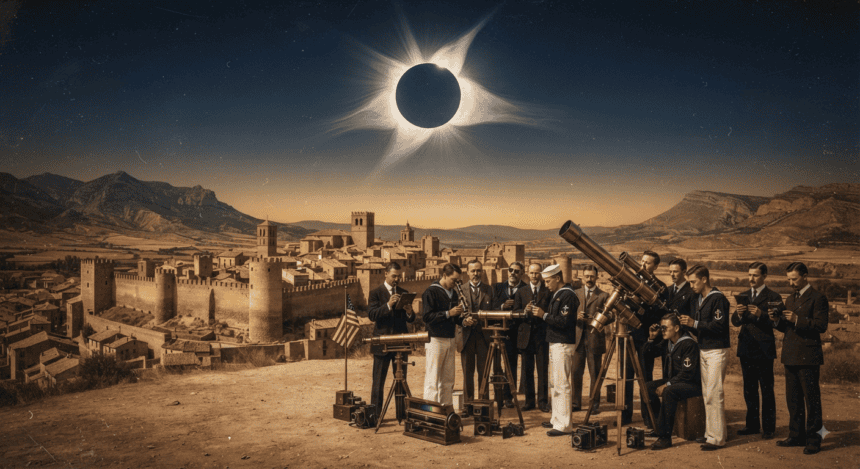
The photographs—grainy, sepia-toned, and remarkably composed—show sailors assisting with heavy, brass-fitted telescopes and glass-plate cameras. These weren’t just mission observers; they were active participants in the era’s “big science.” The ship’s logs from that summer detail the frantic calibration of equipment and the precise navigation required to keep the vessel steady in the Atlantic swell.
What makes these images significant isn’t just the celestial event itself, but the intersection of military logistics and pure scientific inquiry. The Navy’s willingness to divert a frontline warship for a astronomical observation highlights a period when the U.S. military leaned heavily into scientific exploration as a component of its growing global reach.
Decades later, these negatives—recovered from naval archives—offer a rare glimpse into the logistical heavy lifting behind early astrophysics. They serve as a reminder that before satellite imagery and automated sensors, capturing the sun’s corona required a crew of hundreds, a steel-hulled cruiser, and a perfect moment of alignment in the middle of the ocean.
The 1905 expedition didn’t solve the mysteries of the sun, but it cemented a partnership between the fleet and the scientific community that would define naval research for the next century. As modern eyes turn to the skies for the next major eclipse, the legacy of the *Minneapolis* remains, etched in silver halide and forgotten logbooks.