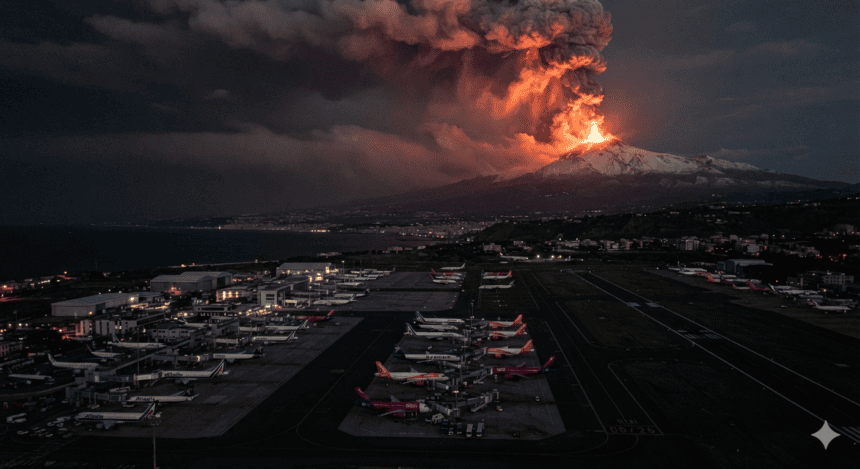
CATANIA, Sicily — Authorities shuttered Catania-Fontanarossa Airport on Friday after Mount Etna launched a fresh burst of volcanic ash across the Sicilian skyline. The eruption, which began in the early morning hours, forced a complete standstill for hundreds of incoming and outgoing flights, leaving thousands of travelers stranded at the height of the summer holiday season.
The airport operator, SAC, confirmed the total suspension of flight activity by mid-morning. Visibility plummeted as thick plumes of ash settled on runways, creating a lethal hazard for jet engines. Ground crews are currently working to clear the debris, but officials have yet to provide a firm timeline for when air traffic might resume.
“We are monitoring the situation hour by hour,” a spokesperson for the airport authority told local media. “Safety is the only priority. Until the ash cloud clears and the runways are verified safe, no planes will take off or land.”
Etna, Europe’s most active volcano, has been in a state of near-constant unrest for weeks. While local residents are accustomed to the mountain’s temperamental nature, this specific event caught authorities off guard with its intensity. The National Institute of Geophysics and Volcanology (INGV) reported that the ash column reached several kilometers into the atmosphere, drifting toward the southeast and impacting air corridors over the Ionian Sea.
For the thousands of tourists currently in Sicily, the disruption is a logistical nightmare. Airlines have scrambled to rebook passengers, but with the peak summer travel period in full swing, empty seats are scarce. Many travelers are now facing lengthy bus rides to alternative airports in Palermo or Comiso, both of which are operating at maximum capacity.
This isn’t the first time the volcano has crippled regional travel. Catania, which serves as the primary gateway to eastern Sicily, sits in the direct shadow of the summit. The airport is frequently forced to pivot operations during periods of intense volcanic activity, a reality that remains a persistent risk for the island’s tourism-dependent economy.
As of Friday afternoon, the volcano’s tremors had slightly subsided, but the ash plume remained a significant presence. Travelers are urged to verify their flight status directly with their airline before heading to the airport, as the situation remains fluid.
Until the winds shift and the crater settles, the runways in Catania will stay silent.