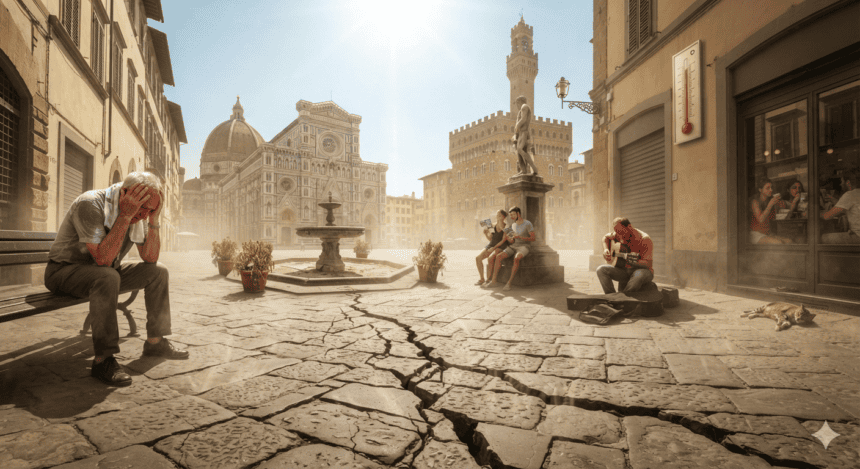
Southern Europe is currently locked in a brutal heat dome, pushing temperatures toward 45°C (113°F) across Greece, Italy, and parts of the Balkans. It is the second major thermal spike of the summer, leaving authorities scrambling to manage infrastructure that was never built for this level of sustained intensity.
For residents in Athens and Rome, the weather isn’t just an inconvenience—it’s a disruption to the basic mechanics of daily life. Schools have shuttered in parts of Greece to protect students, while the Acropolis, the country’s most visited landmark, has restricted operating hours to prevent heat-related emergencies among tourists.
The human cost is mounting. Emergency rooms report a surge in heatstroke cases, particularly among the elderly and outdoor laborers. In Italy, the Ministry of Health has issued “red alerts” for several major cities, signaling that the heat is a threat even to healthy individuals. The grid is also feeling the strain. As air conditioning units run at maximum capacity, energy providers are bracing for potential outages, a scenario that would leave millions vulnerable in the middle of a furnace-like week.
Climate scientists point to a shift in the jet stream that has essentially parked a high-pressure system over the Mediterranean. This isn’t a freak occurrence anymore; it’s a recurring pattern. Data from the Copernicus Climate Change Service confirms that the last decade has seen a consistent upward trend in the frequency and severity of these “heat events.”
Economic fallout is already rippling through the region. Agricultural sectors, particularly in the Po Valley, are struggling with record-low soil moisture. Crops are withering in the fields, threatening yields for staple goods like olives and grains. Insurance adjusters are already calculating the long-term impact on infrastructure, as asphalt roads buckle and rail lines face speed restrictions to prevent warping.
Local governments are trying to adapt, but the pace of change is lagging behind the temperature gauges. “We are in a race against a climate that is moving faster than our urban planning,” said one regional civil protection official in Rome. He declined to offer a timeline for when the city might be fully equipped to handle such sustained heat, noting only that “the current measures are temporary stopgaps.”
The forecast offers little relief. While meteorologists expect a slight dip in the coming days, the respite will be brief. The atmosphere has trapped enough heat to ensure that even the nights—which used to offer cooling—now remain stifling, denying the land and the people any chance to recover.