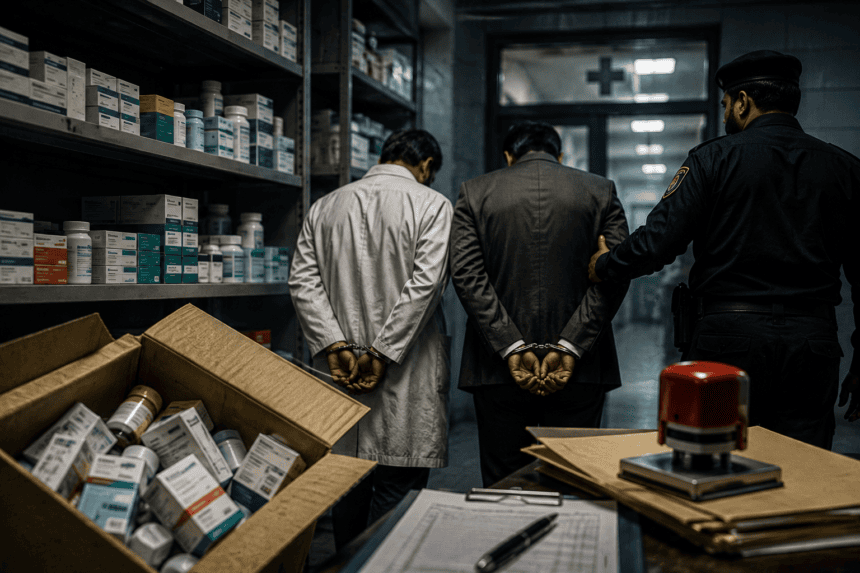
GUJRANWALA — Health authorities suspended two senior officials at the District Headquarters (DHQ) Hospital on Wednesday, following the discovery of a large-scale medicine theft that left the facility’s pharmacy dangerously depleted.
The action follows a surprise audit ordered by the provincial health department after patients repeatedly complained about the lack of essential supplies. Investigators found that high-value antibiotics and emergency cardiac medications had been systematically siphoned off over several weeks, likely to be sold on the black market.
Medical Superintendent Dr. Sohail Anjum confirmed the suspensions, identifying the storekeeper and the pharmacy in-charge as the primary targets of the inquiry. Both men were barred from hospital premises late Tuesday night as the local police registered a formal case.
“We aren’t just looking at missing inventory,” a senior health department official said. “We are looking at a coordinated breach of trust that put patients’ lives in direct danger.”
The theft isn’t an isolated incident. For months, patients visiting the DHQ Hospital were frequently handed prescriptions and told to purchase life-saving drugs from private pharmacies outside the gate. Many families, struggling with rising inflation, had accused staff of hoarding supplies to create artificial shortages.
The audit team reportedly uncovered a discrepancy of millions of rupees in the pharmacy’s stock records. They found that while digital logs showed regular deliveries, physical shelves remained bare. Security cameras, which might have captured the movement of stock, were allegedly disabled during the overnight shifts when the bulk of the theft occurred.
Police are now interrogating the suspended staff to determine if the operation involved higher-level management or external suppliers.
The hospital’s pharmacy remains under police seal as investigators finish their final audit of the remaining stock. For now, the facility is relying on emergency supplies transferred from nearby rural health centers, but the loss of specific critical-care medications remains a significant hurdle for doctors on the front lines.