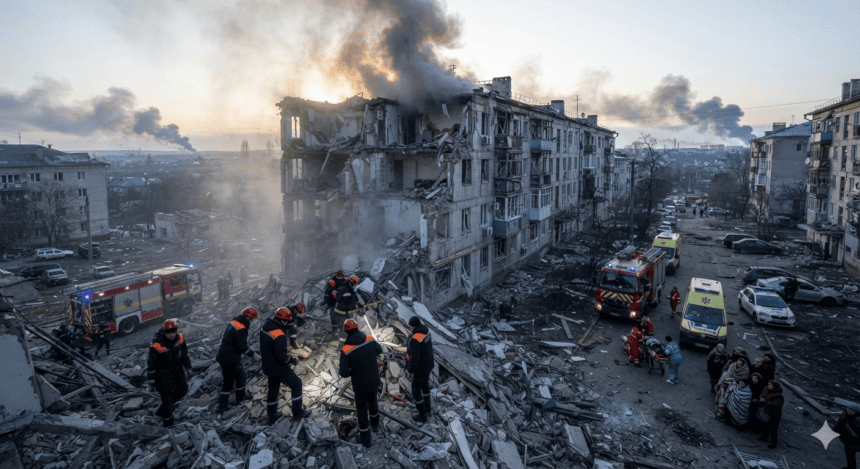
Five people are dead and dozens injured following a coordinated wave of Russian aerial strikes that hit civilian infrastructure across Ukraine early Tuesday. The assault, which utilized a mix of cruise missiles and Iranian-designed drones, targeted residential sectors in at least four major cities, marking one of the most intense barrages in recent weeks.
The capital, Kyiv, faced a relentless onslaught for three hours. While local air defenses intercepted several incoming projectiles, debris from a downed missile tore through a multi-story apartment block in the Obolon district. Emergency crews spent the morning pulling residents from the rubble.
In the eastern city of Kharkiv, a separate strike leveled a local market, killing two people instantly. The facility was crowded with morning shoppers at the time of impact. Regional governor Oleh Syniehubov confirmed that rescue operations are ongoing, though the threat of “double-tap” strikes—where Russia hits the same location after emergency services arrive—has hampered the pace of the cleanup.
The timing of this escalation coincides with renewed debates in Western capitals regarding the use of long-range weaponry. Ukraine’s leadership has spent days lobbying for the removal of restrictions on using supplied missiles to strike airbases deep inside Russian territory. They argue that the current defensive posture leaves the country’s population vulnerable to launch sites that operate with total impunity.
Military analysts noted that the scale of this attack suggests a shift in targeting strategy. Rather than focusing solely on energy infrastructure, the Russian military appears to be deliberately hitting high-density residential zones. This pattern, according to defense experts, is intended to degrade public morale as winter approaches and the frontline in the Donbas remains locked in a grinding stalemate.
The Kremlin has yet to issue a detailed statement on the specific targets, maintaining its standard stance that it only strikes military-linked facilities. However, the visual evidence from the ground—shattered apartments, scorched vehicles, and civilian casualties—tells a different story.
As the sun sets over Kyiv, the scale of the damage is still being tallied. For the families in Obolon and Kharkiv, the silence that followed the air raid sirens is brief. With power grids flickering and another cold night ahead, the reality remains that for those living under the flight path, the war is not a distant frontline battle—it is a daily fight for survival.