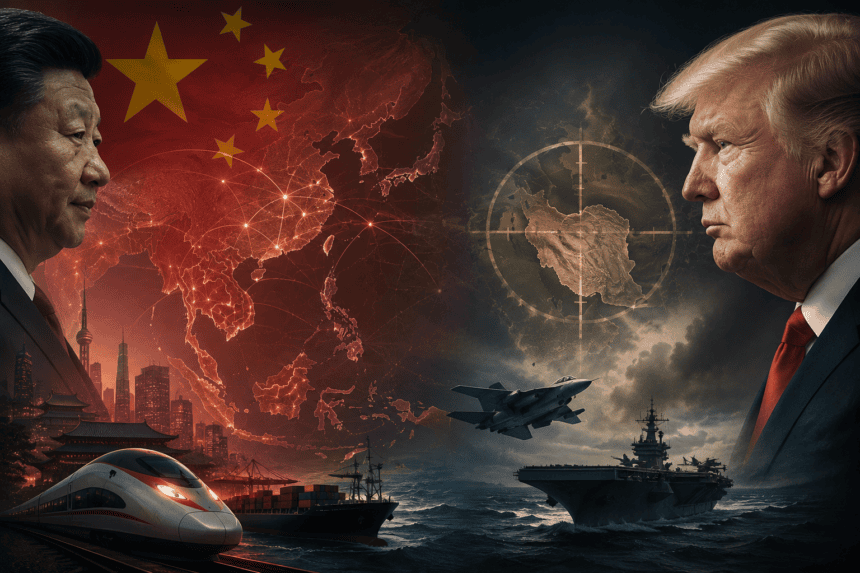
Donald Trump is signaling a return to a “maximum pressure” campaign against Tehran, a move that threatens to drain U.S. diplomatic and military bandwidth just as Beijing accelerates its territorial ambitions across the Indo-Pacific.
While the incoming administration prioritizes a confrontational stance toward Iran, China is quietly cementing its grip on the South China Sea. Beijing’s recent maneuvers—ranging from aggressive maritime incursions near the Second Thomas Shoal to expanded naval drills—suggest a calculated effort to test the limits of U.S. distraction.
The strategy in Washington appears to be a preference for middle-east dominance over containment in the Pacific. Trump’s transition team has already begun vetting hardliners for key cabinet positions, all of whom share a singular focus on isolating the Iranian regime. This obsession with Tehran risks creating a power vacuum in Asia, one that Xi Jinping is eager to fill.
“The U.S. is playing a zero-sum game,” said a senior fellow at a Washington-based security think tank. “By tethering the defense budget and diplomatic energy to a potential conflict with Iran, the White House is essentially giving Beijing a green light to rewrite the status quo in the Taiwan Strait.”
The shift marks a departure from the “Pivot to Asia” doctrine that defined U.S. foreign policy for much of the last decade. During his previous term, Trump’s trade wars with China were fueled by economic grievances, but his current focus on Iran suggests a retreat toward traditional, resource-heavy interventionism.
For regional allies like the Philippines and Japan, the message is unsettling. They rely on the U.S. naval presence to deter Chinese encroachment. If the U.S. Seventh Fleet is forced to redirect assets toward the Persian Gulf, the regional security architecture in the Pacific will fray.
Beijing isn’t waiting for an invitation to move. Recent satellite imagery confirms an expansion of runway facilities and missile bunkers on artificial islands, signaling a long-term commitment to military dominance.
The administration’s Iran-first approach offers a clear trade-off: a harder line in the Middle East at the expense of a crumbling containment strategy in the East. As Trump prepares to occupy the Oval Office, the question is not whether he can contain Iran, but whether he can afford to ignore the rising superpower on the other side of the globe.