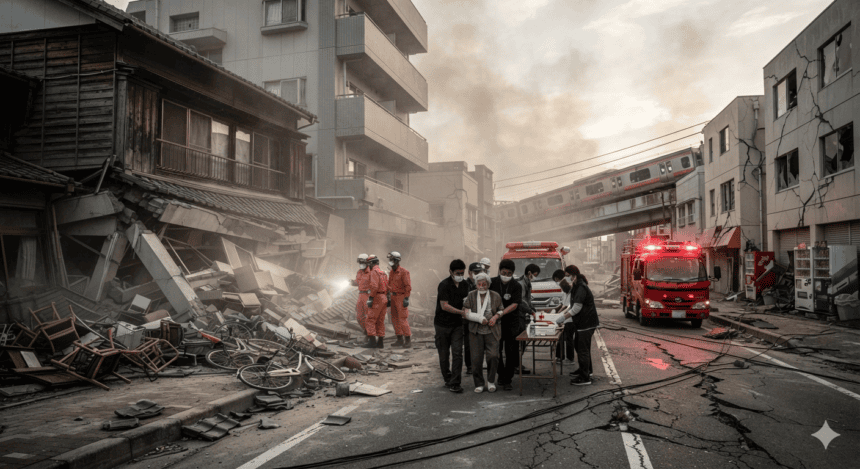
TOKYO — A 5.9 magnitude earthquake struck off the coast of Fukushima prefecture late Tuesday, sending residents into the streets and leaving at least 37 people injured across the region.
The tremor hit at 11:29 p.m. local time, centered at a depth of 50 kilometers. While the Japan Meteorological Agency confirmed no tsunami warning was issued, the intensity of the shaking—registering a strong 5 on the Japanese seismic scale—was enough to knock furniture over and trigger automatic power shut-offs in thousands of homes.
Most of the injuries, primarily cuts and bruises from falling objects, were reported in Fukushima and neighboring Miyagi prefectures. Local fire departments confirmed that while the majority of victims were treated and released, three people remain hospitalized with bone fractures.
“The shaking felt different this time,” said Kenji Sato, a resident of Soma city. “It started with a sharp jolt, then a long, rolling sway that felt like it wouldn’t stop.”
Rail operators suspended service on several Shinkansen bullet train lines immediately following the quake. Technicians spent the early morning hours checking tracks for potential hairline fractures, causing significant delays for Wednesday morning commuters.
Nuclear regulators moved quickly to address public anxiety. Both the Tokyo Electric Power Company (TEPCO) and regional authorities reported no abnormalities at the Fukushima Daiichi or Daini nuclear plants. Monitoring stations in the area showed radiation levels remained within normal ranges throughout the night.
Geologists view this event as an aftershock—a lingering adjustment of the tectonic plates still settling since the devastating 2011 disaster that reshaped the region’s coastline.
For the people of eastern Japan, the quake serves as a sharp reminder of their geography. While the infrastructure held firm, the psychological toll of another midnight emergency lingers.
Authorities have warned residents to remain vigilant for potential aftershocks of a similar magnitude over the next 48 hours.