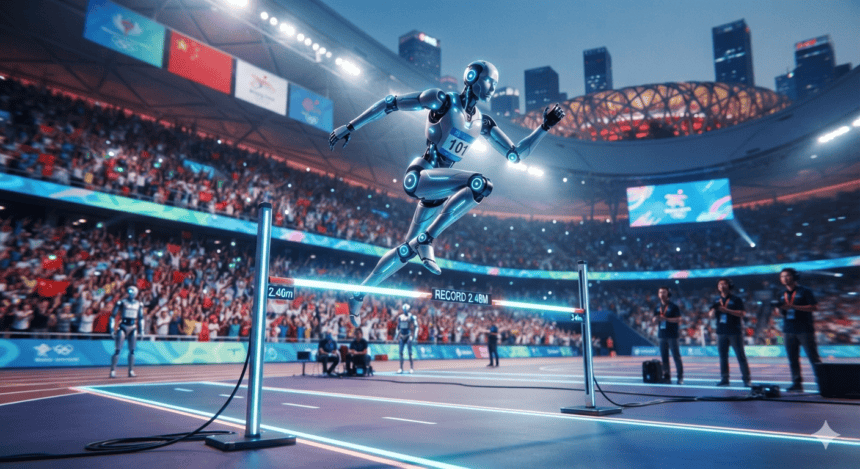
Beijing’s latest robotics showcase ended Sunday with a series of performance benchmarks that suggest humanoids are moving out of the lab and toward the factory floor. Engineers at the Beijing Robot Games reported that several prototype models eclipsed previous speed and stability records, signaling a shift in how these machines handle complex, uneven terrain.
The event, held at the Beijing Economic-Technological Development Area, focused on real-world utility rather than simple aesthetics. While past iterations of humanoids often struggled with basic balance, the current crop navigated obstacle courses at speeds previously reserved for wheeled robots. One unit from a local startup completed a 100-meter sprint in under 20 seconds, a massive leap from the cautious, shuffling gaits of just two years ago.
For the industry, the implications are immediate. Investors are no longer looking for toys; they are looking for scalable labor. The hardware on display featured improved actuators and proprietary AI models capable of “learning” a new environment in milliseconds rather than hours. This allows the robots to adapt to shifting debris or changing floor plans without needing a manual reset from a human technician.
“The hardware is finally catching up to the software,” said Li Wei, an automation consultant who attended the games. He noted that the primary hurdle remains battery life, which for most units still caps out at roughly 90 minutes of high-intensity movement. “We’ve solved the balance. We’ve solved the vision. Now, we’re just waiting for the power density to match the ambition.”
Despite the performance gains, the machines showed occasional, sharp stumbles when transitioning from smooth concrete to synthetic grass—a reminder that “human-like” motion remains an incredibly difficult engineering problem. The judges, however, prioritized consistency over raw speed, awarding the top prize to a unit that prioritized steady, repeatable tasks over flashy displays of agility.
The event concluded with a clear message to global competitors: China’s robotics sector is pivoting toward mass production. With several firms announcing plans to integrate these humanoids into logistics hubs by early 2026, the era of the industrial humanoid is no longer a matter of ‘if,’ but ‘how soon.’
Whether these machines can truly replace human workers in hazardous environments remains the industry’s biggest open question. For now, the robots have proven they can run, climb, and adapt—and they aren’t slowing down.