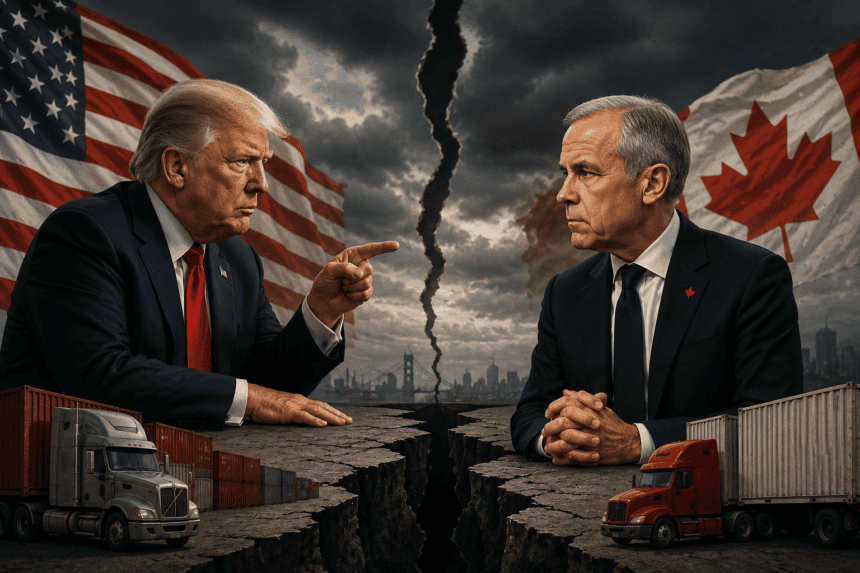
WASHINGTON: US President Donald Trump has reignited his controversial rhetoric about Canada becoming part of the United States, saying Canada wants the “benefits of being a State, without being one” after trade negotiations between Washington and Ottawa collapsed.
Trump made the remarks in a post on Truth Social, marking his first major response to the breakdown in the latest US-Canada trade negotiations. He also criticised Canada’s trade policies and accused the country of imposing high tariffs on American farmers.
Trade Talks Collapse
The latest negotiations between the two neighbouring countries broke down after the sides failed to reach an agreement on several major trade issues.
The collapse was followed by the implementation of 50% US tariffs on around $20 billion worth of Canadian goods. The new duties cover a range of products and represent another significant escalation in the already tense trade relationship between the two countries.
The talks had initially raised hopes of reaching an agreement that could ease trade restrictions affecting industries including steel, aluminium and automobiles. However, disagreements over tariffs and other conditions ultimately prevented a deal.
Trump Revives ‘51st State’ Remark
Trump’s latest statement also revived his long-running suggestion that Canada should become the 51st US state.
The US president has repeatedly raised the idea since late 2024, although Canadian leaders have consistently rejected the proposal and stressed that Canada’s sovereignty is not negotiable.
Trump’s latest comments came amid the escalating trade dispute and appeared to link the economic relationship between the two countries with his argument that Canada benefits from its close ties with the United States without becoming part of the US.
Canada Announces Retaliatory Tariffs
Canadian Prime Minister Mark Carney has responded to the latest US tariffs by announcing retaliatory measures against American products.
Canada plans to introduce dollar-for-dollar tariffs from September 8, targeting a range of US goods, including steel, dairy products, electronics and agricultural equipment. Carney has rejected what he considers unfair US demands and defended Canada’s right to protect its economic interests and sovereignty.
The Canadian government has also criticised Washington for using the countries’ close economic integration as leverage in negotiations.
Growing Risk of a Trade War
The latest confrontation has raised fears of a broader US-Canada trade war, potentially affecting businesses and consumers on both sides of the border.
The two countries have one of the world’s largest bilateral trading relationships, with hundreds of billions of dollars in goods and services moving across their shared border each year. A prolonged tariff dispute could increase costs for businesses, disrupt supply chains and put upward pressure on consumer prices.
The dispute could also create uncertainty around the future of the US-Mexico-Canada Agreement (USMCA), which provides the framework for much of North American trade.
Relations Under Increasing Strain
Trump’s latest remarks come at a particularly sensitive moment in US-Canada relations. While both countries remain major economic partners, disagreements over tariffs, trade policy and Canada’s sovereignty have increasingly strained diplomatic ties.
Carney has maintained that Canada will defend its national interests while continuing to seek a workable economic relationship with the United States.
For now, however, the collapse of negotiations and the introduction of new tariffs have pushed the two allies further toward a potentially damaging trade confrontation.