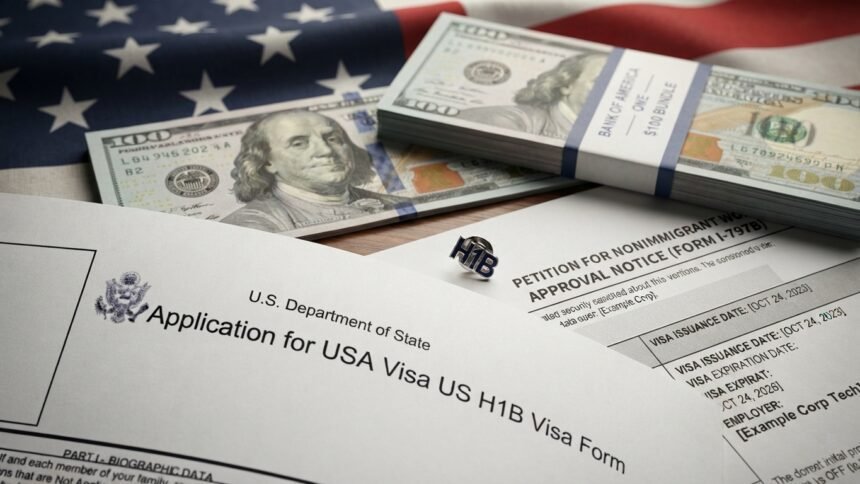
WASHINGTON: The administration of US President Donald Trump has proposed a regulation that would make permanent an unprecedented $103,265 fee on new H-1B visas for highly skilled foreign workers.
The proposed rule, published by the US Department of Homeland Security in the Federal Register on Monday, follows a temporary fee introduced by Trump last year. The measure has faced legal challenges and was blocked by a federal judge in June.
The Boston-based appeals court is currently reviewing the ruling, while another court is considering a separate legal challenge brought by a major business group.
Trump’s temporary fee is due to expire in September, one year after it was introduced. The newly proposed regulation could be finalised by the end of this year.
The H-1B programme allows US employers to hire foreign workers in specialised fields. It provides 65,000 visas annually, along with an additional 20,000 visas for workers with advanced degrees. Visas are generally issued for periods of three to six years.
Before Trump’s temporary measure, H-1B-related fees generally ranged between $2,000 and $5,000.
The proposed fee would not apply to foreign nationals already in the United States on student visas who later obtain H-1B status, or to renewals of existing H-1B visas.
The H-1B programme has become a major point of debate in the United States. Trump and other critics argue that some companies use the programme to replace American workers with less expensive foreign labour.
Business groups and many employers, however, argue that the programme is necessary to address shortages of qualified workers and allow American companies to recruit highly skilled international talent.
According to court filings, around 70 employers had paid the $100,000 fee on 85 visa applications by late February.
The fee is being challenged by the US Chamber of Commerce, Democratic-led states and a coalition of unions and employers.
The lawsuits argue that presidential authority to restrict the entry of foreign nationals does not allow the administration to override the law establishing the H-1B programme. They also claim that the Department of Homeland Security cannot impose revenue-generating fees without congressional approval.
The Trump administration has argued that the charge is not a traditional tax and that courts have limited authority to interfere with the president’s power to restrict entry into the United States.
The proposal comes amid broader immigration restrictions introduced by the Trump administration. US Citizenship and Immigration Services data showed that employers registered for around 344,000 H-1B visas last year, more than 25% fewer than in 2024 and less than half the 794,000 applications recorded in 2023.
The administration has also introduced enhanced screening for H-1B applicants and proposed a new selection system that would give preference to higher-skilled and higher-paid workers.
Earlier this month, the Department of Homeland Security separately proposed fees of up to $4,500 for applications to extend the stay of H-1B workers or transfer employees working from outside the United States.